
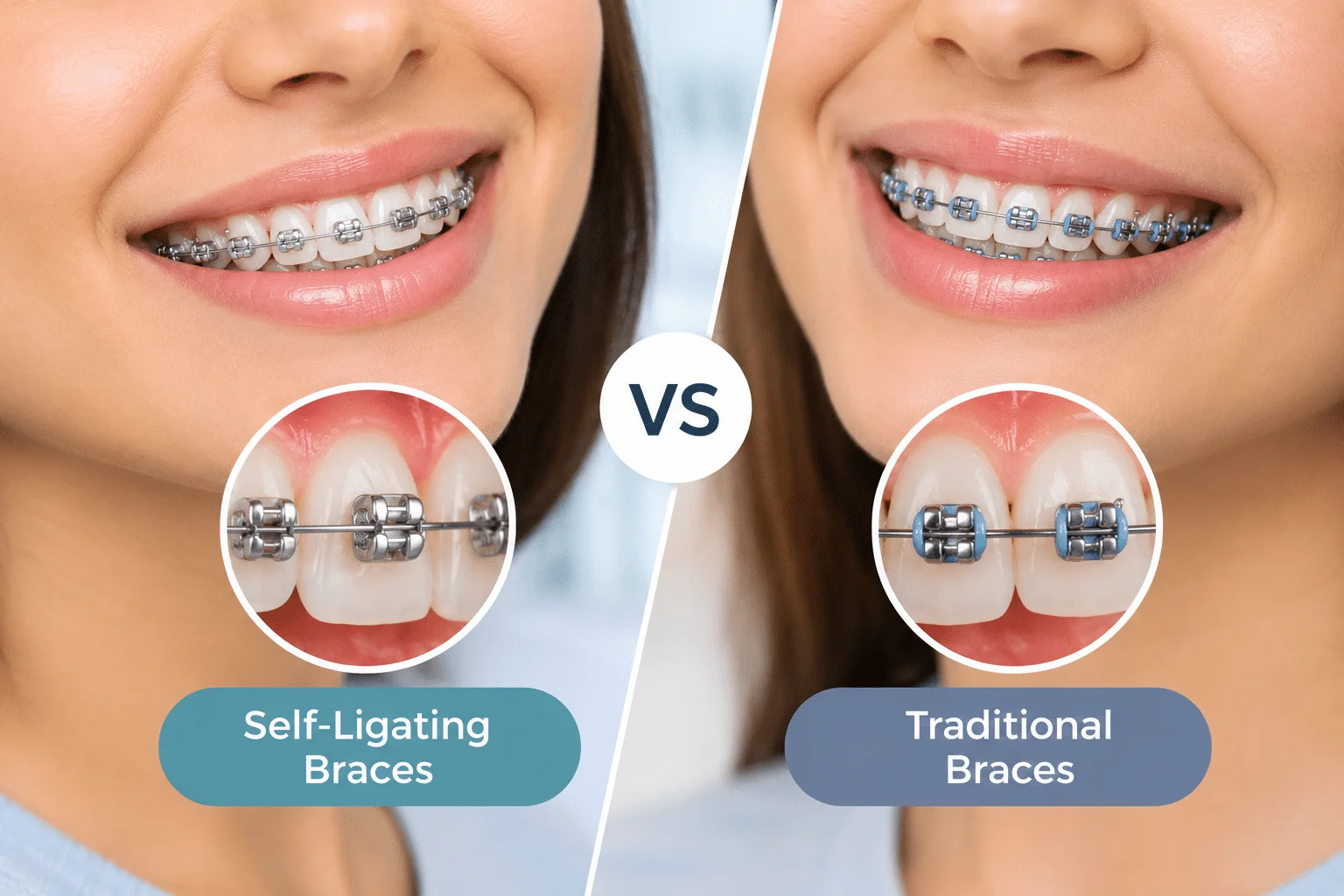
When comparing self-ligating vs traditional braces, the main difference is how the archwire is held inside the brackets. Self-ligating braces use a built-in mechanism, while traditional braces usually use elastic or wire ligatures to secure the archwire.
That design difference can affect how the appliance is managed during treatment, but it does not mean that self-ligating braces are automatically faster, less painful or better for every patient. Research comparing the two systems has not established a consistent overall advantage for self-ligating brackets in treatment duration, discomfort or the total number of appointments. The most suitable option depends on your teeth, bite, treatment objectives and the orthodontic plan developed for you.
If you are considering self-ligating braces in JLT, understanding the practical differences can help you have a more informed discussion with your orthodontist.
For adults, teenagers and parents comparing fixed braces in Dubai, the important question is usually not which system is universally better. It is which treatment approach may be appropriate for the individual patient after a proper orthodontic assessment.
Differences Between Self-Ligating and Traditional Braces
| Feature | Self-ligating braces | Traditional braces |
| How the archwire is held | A built-in bracket mechanism holds the wire | Elastic ties or wire ligatures usually hold the wire |
| Visible elastic ties | Not typically required to secure the archwire | Commonly used with conventional bracket systems |
| Bracket design | Includes a clip, door or similar mechanism | Uses a conventional bracket design with ligatures |
| Comfort | Individual experience varies; not consistently proven to be less painful | Individual experience varies |
| Treatment time | Depends on the individual case and treatment plan | Depends on the individual case and treatment plan |
| Appointment needs | Depends on treatment planning and clinical monitoring | Depends on treatment planning and clinical monitoring |
| Cleaning | Requires careful brushing around brackets and wires | Requires careful brushing around brackets, wires and ligatures |
| Suitability | May be appropriate for selected cases | May be appropriate for selected cases |
The table provides a practical overview, but the differences should not be interpreted as a ranking. Both systems are established fixed orthodontic approaches.
The mechanism used to hold the archwire is the clearest technical distinction. However, clinical outcomes can depend on many other factors, including the diagnosis, treatment mechanics, orthodontist’s treatment plan and the patient’s individual response to treatment.
How Each Bracket System Holds the Archwire
All fixed braces use brackets attached to the teeth and an archwire that applies controlled forces as part of orthodontic treatment.
With self-ligating braces, the bracket includes its own mechanism for holding the archwire. Depending on the bracket design, this may involve a clip, door or similar built-in feature. This is why self-ligating braces are often described as braces without elastic ties.
Traditional fixed braces use a conventional bracket design. The archwire is commonly secured using small elastic ligatures or, in some situations, wire ligatures.
If you are comparing self-ligating braces with metal braces, it is important to understand that “traditional” describes the method of ligation rather than meaning that conventional braces cannot be used for modern orthodontic treatment.approach
Both systems can form part of a carefully planned orthodontic . The choice of bracket system is only one element of the wider treatment plan.
Comfort and Friction: What Can and Cannot Be Claimed
Self-ligating braces are often discussed in relation to reduced friction because their built-in mechanism removes the need for conventional elastic ligatures to hold the archwire.
However, reduced friction in a mechanical sense should not automatically be translated into a guarantee of less discomfort for every patient.
Orthodontic discomfort is influenced by several factors, including the stage of treatment, the type of tooth movement being carried out and individual sensitivity. Systematic reviews comparing self-ligating and conventional brackets have not shown a consistent significant difference in patient discomfort during the early stages of treatment.
This is why it would not be medically accurate to say that self-ligating braces are always less painful. Some patients may have different personal experiences with different appliances, but an individual experience should not be presented as a guaranteed outcome for everyone.
During your consultation, your orthodontist can explain what to expect from fixed-braces treatment and how your particular treatment plan may influence comfort at different stages.
Appointment Pattern and Treatment Time
Another common claim is that self-ligating braces always require fewer appointments or complete treatment faster.
The available evidence does not support making that promise for every patient. A systematic review comparing self-ligating and conventional brackets found no significant overall difference in the number of appointments or total treatment time in the studies analysed. More recent evidence reviews have similarly found that most measured differences between bracket systems were not statistically significant.
That does not mean every appointment will be identical for both systems. Because the way the archwire is engaged differs, certain chairside procedures may be managed differently. However, the overall appointment pattern for a patient depends on the orthodontic plan, treatment stage, tooth movement required and the need for clinical monitoring.
For the same reason, there is no responsible generic answer to how long either type of braces will take.
Your orthodontist will assess the alignment, bite and treatment objectives before discussing the expected treatment stages. Any estimate should be individual rather than based on a general promise that one bracket system is always faster.
Oral Hygiene, Food and Maintenance
Both self-ligating and traditional braces require careful oral hygiene.
Brackets and wires create additional surfaces around which food debris and plaque can collect. Good brushing technique, appropriate interdental cleaning and regular dental advice remain important regardless of the bracket system selected.
Self-ligating braces do not have conventional elastic ties holding the archwire in place, which changes the design of the appliance. However, research has not established a consistent clinical advantage showing that self-ligating brackets are easier to keep clean or provide better overall plaque control than conventional brackets.
For patients, the practical takeaway is straightforward: neither system removes the need for consistent oral hygiene.
Food advice may also depend on the orthodontic appliance and your treatment instructions. Hard, sticky or difficult-to-manage foods can damage brackets or other orthodontic components. Your orthodontist or dental team should provide individual guidance about caring for your braces.
If you are choosing between systems partly because of cleaning concerns, ask your orthodontist to demonstrate the recommended cleaning approach for the appliance being considered.
Metal and Ceramic Appearance Options
Appearance can be an important consideration, particularly for adults and teenagers who prefer their fixed braces to be less noticeable.
Traditional braces are commonly associated with metal brackets and visible elastic ligatures. However, fixed orthodontic treatment is available in different designs and materials.
Ceramic brackets may offer a less noticeable appearance because they can be tooth-coloured or made from materials designed to blend more closely with the teeth. Patients considering this type of appliance can explore ceramic braces as part of a wider discussion about fixed-brace options.
Self-ligating brackets can also be available in different materials and designs, depending on the treatment system and what is appropriate for the patient’s case.
However, appearance should not be the only deciding factor. A bracket that is less noticeable may not necessarily be the preferred option for every treatment plan. Your orthodontist will consider the clinical requirements alongside your preferences and explain which options may be suitable.
Which System May Suit Complex Bite or Alignment Needs?
Both self-ligating and conventional fixed-brace systems can be used within orthodontic treatment planning.
It would therefore be misleading to say that one system is automatically suitable for every complex case while the other is not.
Complexity can involve different concerns, including significant crowding, spacing, tooth position and bite relationships. The appropriate treatment mechanics depend on the diagnosis rather than simply on whether the brackets are self-ligating or conventional.
Research does not support a universal conclusion that one bracket system consistently produces superior outcomes across all orthodontic cases.
At Dental Oasis, the available orthodontics at Dental Oasis include different treatment approaches. Your orthodontist will assess your teeth and bite before recommending an option based on your individual treatment requirements.
For some patients, self-ligating braces may be considered. For others, conventional fixed braces or another orthodontic approach may be more appropriate.
The right question is not, “Which braces can treat everything?”
A more useful question is, “Which treatment approach best fits my diagnosis and treatment goals?”
Questions An Orthodontist Considers Before Recommending Either Option
Choosing between self-ligating and traditional braces involves more than selecting a bracket design. Before making a recommendation, an orthodontist may consider factors such as:
Your current tooth alignment
Crowding, spacing and individual tooth positions can influence treatment planning.
Your bite relationship
The relationship between the upper and lower teeth is an important part of orthodontic assessment.
The type of tooth movement required
Different treatment objectives may require specific planning and mechanics.
Your age and stage of dental development
This can be relevant when planning treatment for children and teenagers.
Your oral health
The condition of the teeth and gums should be considered before and during orthodontic treatment.
Your appearance preferences
Some patients may prefer a less noticeable fixed-brace option where clinically appropriate.
Your ability to maintain oral hygiene
Any fixed appliance requires careful cleaning and ongoing cooperation with oral hygiene instructions.
Your treatment goals
The objective may involve tooth alignment, bite improvement or other orthodontic concerns identified during assessment.
The orthodontist brings these factors together to develop an individual treatment plan rather than choosing an appliance based on a general online ranking.
Frequently Asked Questions
- Do self-ligating braces work faster than traditional braces?
Self-ligating braces are not proven to work faster than traditional braces in every case. Systematic reviews comparing the two systems have not found a consistent significant difference in overall treatment time. The duration of orthodontic treatment depends on the individual diagnosis, treatment plan and clinical response.
- Are self-ligating braces less painful?
Self-ligating braces should not be described as automatically less painful. Research comparing self-ligating and conventional brackets has not shown a consistent significant difference in discomfort during the early stages of treatment. Individual experiences can vary, and your orthodontist can explain what to expect from your treatment plan.
- Which braces are easier to clean?
Both self-ligating and traditional braces require careful brushing and cleaning around brackets and wires. Although the designs differ, clinical evidence has not shown a consistent overall oral-hygiene advantage for self-ligating brackets. Your cleaning habits and technique remain important with either system.
- Can self-ligating braces treat complex orthodontic cases?
Self-ligating braces might work for some people. This includes some patients who have complex orthodontic problems, but still, it depends on what your orthodontist checkup and what your plan is. Regular fixed braces can also help with many different orthodontic issues. Your orthodontist will assess the best approach for your teeth and bite.
- How can I know which type of braces suits me?
You should decide after a full orthodontic assessment. Your orthodontist will check your teeth, how your bite lines up, and your mouth health. They will also ask about your treatment goals before explaining the options that may fit you best. The final recommendation should match your own needs, not a general claim that one brace type is always better.
Fixed Braces Consultation in JLT Dubai
Self-ligating and traditional braces differ in their bracket design and the way the archwire is secured, but neither system can be described as the best choice for every patient.
The most appropriate option depends on your teeth, bite, oral health, treatment objectives and the orthodontic plan developed after assessment.
If you are comparing self-ligating and traditional braces, a personalised orthodontic assessment can help you understand which options may be appropriate for your individual needs. Your orthodontist can assess your case and explain the practical differences relevant to your treatment rather than recommending one system based on a general claim.
