
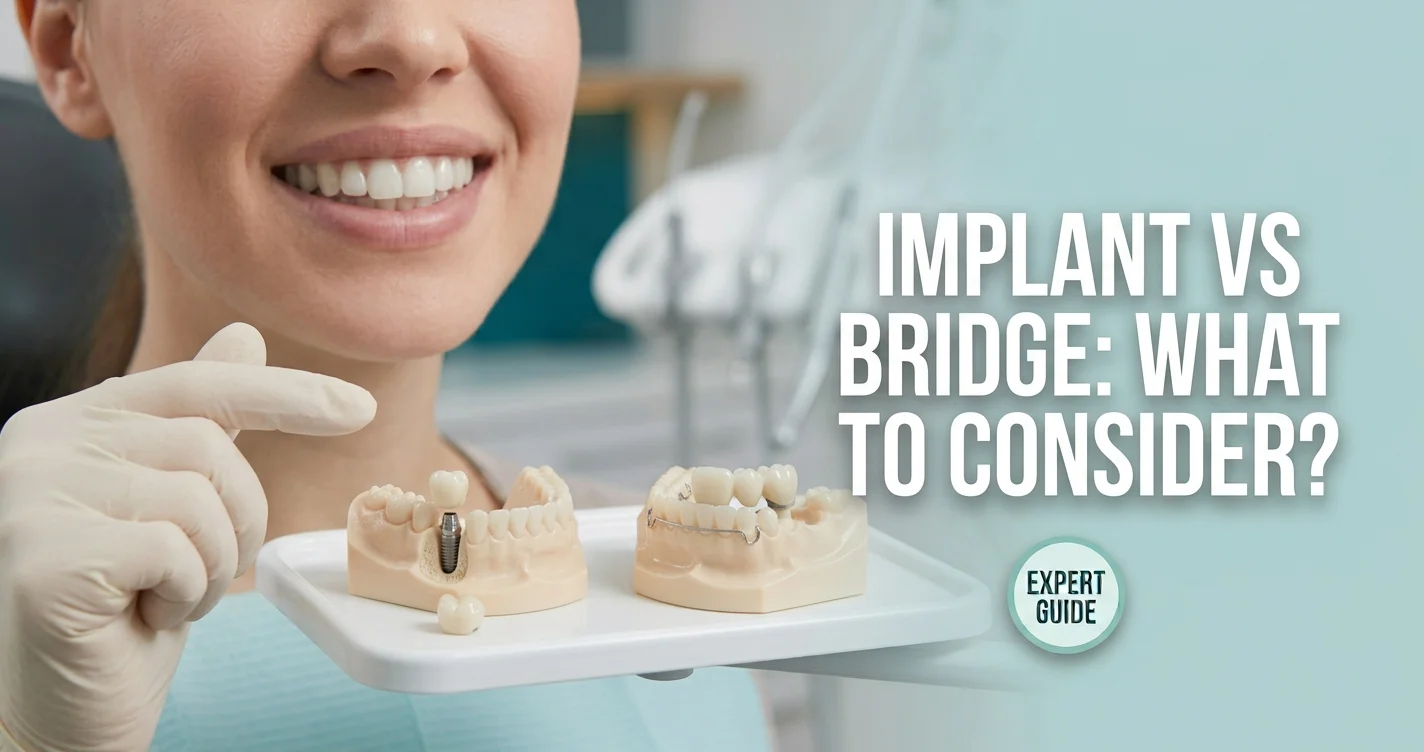
A dental implant replaces a missing tooth with a post placed in the jawbone that supports a crown, while a bridge replaces it with an artificial tooth held by crowns on the teeth either side of the gap. Both can restore appearance and chewing, but they differ in how they treat neighbouring teeth, whether surgery is needed, how long treatment takes and how each is maintained. Neither is the right answer for everyone. The decision depends on your bone and gums, the teeth next to the gap, your general health and your priorities. This guide sets out what a dentist considers so you can have a better-informed consultation.
Key takeaways
- An implant replaces the root and crown; a bridge replaces the crown using neighbouring teeth for support.
- A traditional bridge needs the supporting teeth to be reshaped, which removes some enamel and cannot be reversed.
- An implant needs enough healthy bone and gum health, and involves surgery and healing time.
- Both need regular cleaning and checkups, and neither is guaranteed to last for life.
- The better option is individual, so avoid a one-size answer.
How each option replaces a tooth
A dental implant is a small threaded post, usually titanium, that is placed in the jawbone to act as an artificial root. After healing, a connector called an abutment and a crown are attached. A single-tooth implant therefore replaces one tooth without involving the teeth either side. You can read about the stages on our dental implants page.
A conventional bridge is made of crowns on the teeth either side of the gap, joined to an artificial tooth in the middle. Cleveland Clinic describes the supporting teeth as abutments and the false tooth as a pontic. Other designs exist, such as a cantilever bridge supported on one side or a resin-bonded bridge with wings bonded to the backs of neighbouring teeth. Resin-bonded bridges are usually used for front teeth because they are not strong enough for the chewing forces on back teeth.
Adjacent teeth and supporting tissues
The biggest practical difference is what happens to the neighbouring teeth. With a traditional bridge, the teeth either side usually need to be reshaped to take crowns, which involves removing some enamel, and this step is irreversible. If those teeth are already heavily filled or crowned, using them as supports may make sense. If they are healthy and untouched, preserving them may be an argument for an implant, which does not involve shaving down the neighbouring teeth.
Bone is the other consideration. An implant sits in bone, which responds to the loading and may help preserve the shape of the jaw, whereas a bridge sits over the gum and does not stimulate the bone beneath the gap. Published patient guidance notes that implants help preserve jawbone, but this does not mean a bridge is a poor choice. It means bone is one factor to weigh.
Bone and gum assessment
An implant needs enough healthy jawbone to hold the post, and the gums should be healthy. Active gum disease, severe bone loss, extensive decay, poor oral hygiene or unmanaged conditions such as diabetes can make implants less suitable until managed. Smoking and vaping can interfere with healing. If bone is lacking, bone grafting may be recommended, and our article on bone grafting before dental implants explains when this can happen.
A bridge also depends on healthy supports. If the teeth either side are decayed, heavily restored or weakened, they can fracture under the load or develop problems later. Your dentist will assess both, using examination and imaging, before recommending anything.
Treatment stages and maintenance
Implant treatment involves a surgical stage, a healing period while the bone fuses with the implant, and then fitting the abutment and crown. The healing phase is commonly measured in months, and you may be given a temporary tooth in the meantime for appearance. A traditional bridge usually takes fewer visits. The supporting teeth are prepared, impressions are taken, a temporary bridge is fitted and a laboratory makes the final bridge, which is then cemented.
Maintenance differs. An implant crown is cleaned much like a natural tooth, with attention to the gum edge. A bridge needs cleaning underneath the false tooth using floss threaders or interdental brushes, because plaque there can cause gum inflammation or decay in the supporting teeth. Both need regular dental checkups. Published guidance gives broad ranges for how long bridges and crowns last, and they will eventually need replacement, so it is better to talk about care and review than about lifetime guarantees.
Individual cost considerations
Cost depends on the number of stages, the materials, whether bone grafting or other preparation is needed, and the dentist’s fees. Implant treatment often involves a higher initial cost, while a bridge may involve less up front but may need replacing sooner or involve treatment of supporting teeth later. What is cheaper in the long term depends on your case, so ask for a full plan that includes review visits and the likelihood of future work. Our guide to dental implant costs covers the factors in more detail.
Comparison table
| Consideration | Single implant | Traditional bridge |
| What replaces the tooth | Post in bone, abutment and crown | Artificial tooth joined to crowns on neighbours |
| Neighbouring teeth | Not involved | Usually reshaped to take crowns |
| Surgery | Yes, with healing time | No surgery |
| Bone needs | Enough healthy bone required | Not applicable, but supports must be sound |
| Treatment time | Longer; months of healing | Typically fewer visits |
| Cleaning | Brush and clean gum edge | Clean under the false tooth |
| Review and replacement | Crown may need replacing in time | Bridge may need replacing in time |
Suitability checklist
- Are the teeth either side of the gap healthy, or already heavily restored?
- Is there enough bone for an implant, or would grafting be needed?
- Are my gums healthy, and have I been treated for gum disease?
- Do I smoke or have a condition that could affect healing?
- How long am I prepared to wait for treatment?
- What are the long-term maintenance and review needs of each option?
- What would happen if one part failed in the future?
Having an assessment in JLT
If you are considering replacing a missing tooth, a restorative assessment can show whether an implant, a bridge or another option such as a crowns and bridges consultation is appropriate. You can request an appointment and the team will confirm availability.
Frequently asked questions
Is an implant better than a bridge?
Not for everyone. Implants avoid shaving neighbouring teeth but need bone, healing time and surgery. Bridges are quicker but involve supporting teeth. Your dentist can advise after an assessment.
Does a bridge damage the teeth next to it?
A traditional bridge requires reshaping the neighbouring teeth to take crowns, which removes some enamel permanently. That is why the health of those teeth matters when choosing.
How long does an implant take compared with a bridge?
Implants involve surgery and months of healing, so overall treatment is longer. Bridges usually need fewer visits. Your dentist can give estimated stages for your case.
Will my implant or bridge last for life?
Neither can be guaranteed for life. Longevity depends on cleaning, gum health, bite forces and regular checkups, and the crown or bridge may need replacement over time.
Can I have an implant if I have lost bone?
Possibly, but you may need bone grafting first, and not everyone is suitable. A dentist can assess bone using imaging.
How do I clean under a bridge?
You usually clean underneath using floss threaders or interdental brushes shown by your dentist, because plaque under the false tooth can cause gum problems and decay.
This article is general patient education. It does not replace an examination or individual advice from a dentist who has assessed your teeth, gums and bite.
Sources and further reading
- Dental Bridges. Cleveland Clinic (medically reviewed; page dated 05/24/2023). https://my.clevelandclinic.org/health/treatments/10921-dental-bridges
- Dental Implants. Cleveland Clinic (medically reviewed; page dated 06/11/2026). https://my.clevelandclinic.org/health/treatments/10903-dental-implants
