
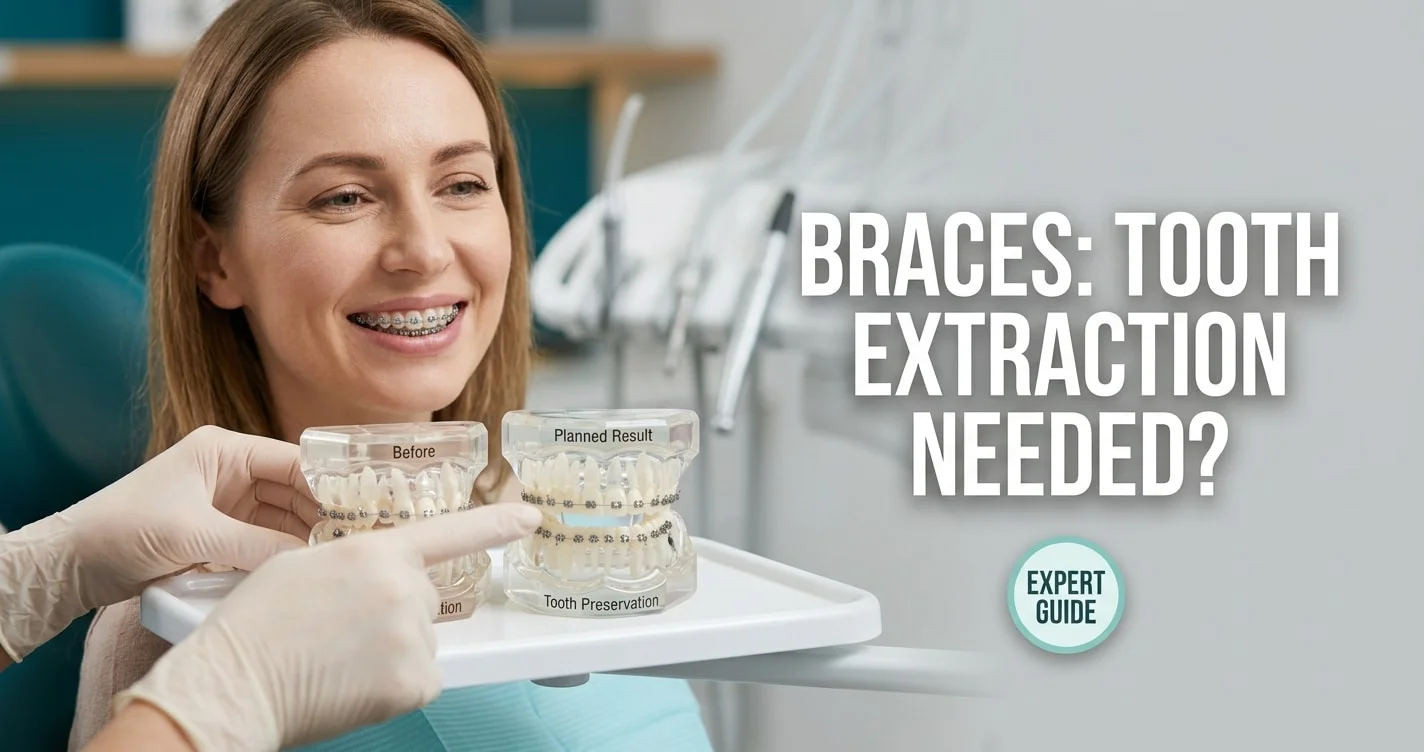
Not every patient needs teeth removed for braces. Extraction is one way an orthodontist can create space when there is not enough room for all the teeth to line up, or when the teeth and bite need to move in a way that cannot be achieved otherwise. Many people complete treatment without it, and for some patients it is the most appropriate option. The decision is made after a detailed assessment, not before it. No brace type, including self-ligating braces, removes the need for a proper space analysis. This article explains how that decision is reached and what to ask.
Key takeaways
- Extraction is sometimes used to create space, but it is neither routine nor automatically avoidable.
- The decision rests on records: examination, photographs, scans or models and radiographs where required.
- Crowding, bite, tooth positions, gum and bone support and facial profile can all influence the plan.
- Alternatives such as expansion or moving teeth backwards may suit some patients but have limits.
- Treat any promise that treatment can always avoid extraction with caution, especially before an assessment.
Why extraction may be considered
Teeth need room to line up. When the jaw cannot accommodate all the teeth, or when front teeth need to be moved back to improve the bite or profile, an orthodontist may consider removing one or more teeth. The British Orthodontic Society explains that in some crowded mouths it is impossible to get a successful result without extractions, and that for many people with more severe crowding extractions may be the best route to a stable result.
There are also risks in avoiding extraction when space is genuinely limited. Straightening a severely crowded mouth without creating room can push teeth outwards, which may leave front teeth or lips more prominent and can risk gum recession if teeth move beyond the supporting bone. This is why the decision is clinical rather than a matter of preference.
What assessment looks like
A responsible extraction decision is based on records. Depending on your case, your orthodontist may take clinical photographs, scans or impressions and radiographs, and examine your bite, gums and any existing dental work. Together these show how much space is needed, how much is available and what the teeth can safely do.
- Amount of crowding or spacing in each arch.
- Tooth size relative to jaw size.
- Position and angle of the front teeth.
- Overbite, underbite, crossbite and how the jaws relate to each other.
- Health of the gums and supporting bone.
- Facial profile and lip support.
- Presence of wisdom teeth, unerupted or missing teeth and previous dental work.
Crowding, bite and other planning considerations
Crowding is the most common reason people ask about extraction, but it is not the only one. A pronounced overjet, where the upper front teeth stick out, may call for space to move them back. A deep bite, an open bite or a mismatch between the upper and lower jaws can also change the plan. Missing or extra teeth alter how much space is available.
Age matters too. Younger patients may still be growing, which can open options not available to adults. Adults may need to consider existing restorations and gum health, which are covered during the assessment.
Does the type of brace change the answer?
Not on its own. Self-ligating brackets, conventional brackets and aligners are different ways of delivering tooth movement, but space is still space. Reviews of trials comparing self-ligating and conventional brackets have not shown that self-ligation removes the need for extractions in a way that would apply to everyone, and the claim has been described as lacking supporting evidence. If you are exploring options, the page on self-ligating braces explains how the system works, but it should not be read as a promise about extractions.
Likewise, it would be wrong to assume extraction is routine. Many patients do not need it. The honest position is that it depends on your teeth, which is why an assessment must come first.
Alternatives where appropriate
Depending on your case, your orthodontist may discuss other ways to gain space. These can include widening the arch, moving back teeth further back, or reshaping a small amount of enamel between teeth, known as interproximal reduction. The British Orthodontic Society notes that expansion and backward movement can create some space for some patients but are not suitable for everybody and are limited in how much they can achieve.
Each approach has its own limits and trade-offs, so it is worth asking why your orthodontist recommends one route over another, and what would change their advice. Our article on treatment time and stages with self-ligating braces shows how the plan is reviewed during treatment, and the comparison of self-ligating and traditional braces may help with questions about the appliance itself.
What happens after the decision
If extraction is part of the plan, your orthodontist will explain which teeth are involved, who will remove them and when. Timing varies. Sometimes extraction is done before the braces go on, and sometimes it is coordinated with the early stages of treatment. Your plan should explain how long each stage is expected to take and what the review points are.
If extraction is not advised, ask what the plan is for creating space and what would trigger a change of approach. A good plan acknowledges that teeth do not always respond as predicted and sets out how it would be reviewed. Being clear on this at the start avoids surprises later and makes it easier to judge whether the advice is balanced.
Whichever route is chosen, retainers will be needed afterwards, and the planned position of the teeth, including closed spaces, will need to be held. Ask what the long-term retention plan involves before starting.
Questions to ask about the recommended plan
- Do you recommend extraction for my case, and what is the reason?
- Which teeth would be involved, and why those teeth?
- What would happen if we did not extract? What are the risks and benefits?
- Which alternatives did you consider, and why were they set aside or chosen?
- How will the spaces be closed, and what will my bite and profile be like?
- Who carries out the extraction, and how does it fit into the timeline?
- Would a second specialist opinion be reasonable?
Getting a clear answer in JLT
If you have been told you may need extractions, or have been promised you will not, the best step is an orthodontic assessment with full records. You can ask Dental Oasis to arrange a consultation and the team will confirm availability.
Frequently asked questions
Will I definitely need teeth removed for braces?
No. Many patients do not. Whether extraction is advised depends on crowding, bite, tooth positions and other factors identified at assessment.
Can self-ligating braces avoid extractions?
They should not be assumed to. Self-ligating brackets change how the wire is held, not how much space you have. Your orthodontist will tell you what space your case needs.
What are the alternatives to extraction?
Depending on the case, options may include arch expansion, moving back teeth backwards or reshaping small amounts of enamel between teeth. Each has limits and may not suit every patient.
Is extraction for braces painful?
Extractions are done under local anaesthetic, so you should not feel pain during the procedure, though some soreness afterwards is common. Your dentist or surgeon will explain aftercare.
Will gaps stay after the teeth are removed?
The planned purpose of extraction is for the space to be used, and braces are used to close it in a controlled way. Your orthodontist will explain how this is planned.
Should I get a second opinion?
It is reasonable if you are unsure about the advice. A second specialist assessment can help you feel confident that the explanation fits your teeth.
This article is general patient education. It does not replace an examination or individual advice from a dentist who has assessed your teeth, gums and bite.
Sources and further reading
- BOS: Why are extractions sometimes necessary as part of orthodontic treatment?. British Orthodontic Society. https://archive.bos.org.uk/BOS-Homepage/Orthodontics-for-Children-Teens/Fact-File-FAQ/FAQ-for-Children-Teens/Why-are-extractions-sometimes-necessary-as-part-of-orthodontic-treatment
- Self-ligating brackets versus conventional pre-adjusted edgewise brackets for treating malocclusion (Cochrane protocol). Cochrane Database of Systematic Reviews. https://cochranelibrary.com/cdsr/doi/10.1002/14651858.CD012407
