
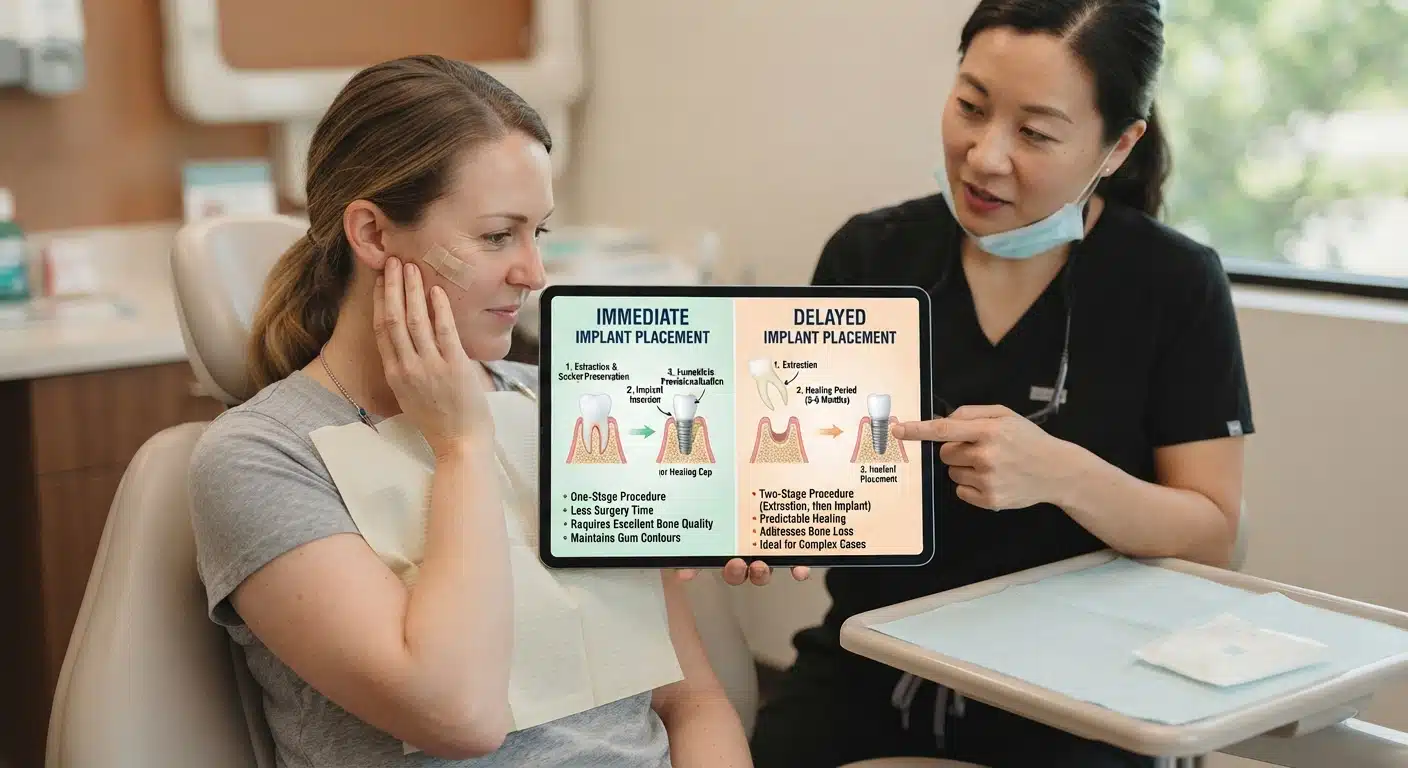
The choice between immediate vs delayed dental implants depends on what the dentist finds at the extraction site and how the surrounding bone, gums, bite and overall health affect treatment planning. An implant can sometimes be placed at the same appointment as a tooth extraction, while in other situations allowing the area to heal first may be the more appropriate approach.
Importantly, immediate implant placement refers to when the implant is placed in relation to tooth extraction. It does not automatically mean that the final crown or tooth replacement is provided on the same day.
For patients considering dental implants in Dubai, implant timing should be decided after an individual assessment. Your implant clinician will examine the tooth and surrounding tissues, review your health history and assess imaging where appropriate before discussing whether immediate, early or delayed placement may suit your situation.
Quick Definitions: Immediate, Early and Delayed Placement
Implant timing is commonly described according to the relationship between tooth extraction, healing and implant placement.
Immediate implant placement
Immediate placement means the dental implant is placed into the extraction site at the same surgical appointment in which the tooth is removed.
This approach may be considered for selected patients when the clinical conditions are suitable. Immediate placement does not mean every extraction site is appropriate for an implant at the same visit.
Early implant placement
Early placement generally refers to implant placement after an initial period of healing rather than immediately at extraction.
The precise timing and terminology can vary according to the clinical situation and treatment approach. The aim is to allow selected healing processes to occur before implant placement while planning the next stage according to the condition of the extraction site.
Delayed implant placement
Delayed placement involves allowing a longer period of healing before placing the implant. This may be considered when the extraction site, bone, gums or wider treatment plan require additional healing or preparation.
The most appropriate approach depends on an individual assessment. A patient should not assume that one timing category is inherently better for every situation.
Implant Placement Versus Immediate Loading: An Important Distinction
The terms immediate placement and immediate loading describe different parts of implant treatment.
Immediate placement
This refers to the timing of the implant surgery. The implant is placed at the same appointment as the tooth extraction.
Immediate loading
Immediate loading refers to placing a restoration or temporary tooth onto an implant within a short period after implant placement, depending on the treatment plan and clinical conditions.
These terms should not be used interchangeably. An implant may be placed immediately after extraction without receiving the final tooth at that appointment. Similarly, a patient may receive a temporary restoration as part of a treatment plan without that restoration being the final crown.
The type and timing of the final restoration depend on the implant’s clinical situation and the wider treatment plan. A crown or bridge may form part of the final tooth-replacement plan once the clinician determines that the appropriate stage has been reached.
When Immediate Placement May Be Considered
Immediate implant placement may be considered for selected patients when the extraction site and wider clinical conditions support this approach.
The implant clinician may assess factors such as:
- The condition of the extraction site
- The amount and shape of available bone
- The condition of the surrounding gum tissues
- The reason the tooth requires extraction
- The presence and extent of infection or inflammation
- The possibility of achieving appropriate implant stability
- The position of the tooth and planned implant
- The bite and forces expected on the restoration
- The patient’s general health and relevant medical history
The decision is not based solely on whether a tooth can be removed and replaced on the same day. Even when immediate placement is technically possible, the clinician may recommend another sequence if it better supports the treatment objectives.
When Healing or Bone Grafting May Need to Come First
Some extraction sites require additional healing or preparation before implant placement.
For example, the clinician may determine that the bone volume, soft-tissue condition or extraction-site characteristics require further treatment planning. A bone graft may be considered in selected cases where additional bone support is needed for future implant treatment.
Depending on the clinical situation, grafting and implant placement may sometimes be planned during the same treatment stage. In other cases, the clinician may recommend allowing the grafted area to heal before placing an implant.
The appropriate sequence depends on factors including the location and extent of the bone deficiency, the planned implant position and the condition of the surrounding tissues. Patients requiring more complex planning may also need coordinated care through oral surgery services.
A recommendation to delay implant placement does not necessarily mean that treatment has gone wrong. In some situations, additional healing or preparation is part of a planned approach designed around the individual clinical findings.
Benefits and Limitations of Each Approach
Immediate and delayed implant placement involve different planning considerations.
| Consideration | Immediate placement | Delayed placement |
| Implant timing | Implant may be placed at the same appointment as extraction | Implant is placed after an appropriate healing period |
| Treatment sequence | May combine extraction and implant placement into one surgical stage for selected cases | May involve separate stages to allow healing or preparation |
| Suitability | Depends on the extraction site, bone, gums and ability to plan stable placement | May be considered when the site needs additional healing, grafting or preparation |
| Final tooth timing | Does not automatically mean the final crown is placed immediately | The final restoration is planned according to healing and treatment progress |
| Planning priority | Requires appropriate conditions at the extraction site | Allows the clinician to reassess the site after healing |
The table provides a general comparison rather than a treatment recommendation. Immediate placement may reduce the number of separate surgical stages in selected cases, but it also requires suitable clinical conditions.
Delayed placement can provide additional time for healing and site development when this is needed. Neither approach should be considered automatically faster, simpler or better for every patient. The treatment sequence should support the clinical objectives rather than being selected primarily because one option appears more convenient.
Role of Infection, Bone, Gums, Bite and Overall Health
Implant timing involves several connected clinical considerations.
Infection and inflammation
The presence and nature of infection or inflammation can affect treatment planning. Your clinician will assess the tooth and surrounding tissues and determine whether the site is appropriate for immediate implant placement or whether additional treatment and healing should be considered.
A previous infection does not allow a general online conclusion about whether an immediate implant is or is not possible.
Available bone
The implant clinician assesses the amount, shape and quality of available bone as part of planning. If the available bone does not support the intended implant position or treatment objectives, grafting or another staged approach may be considered.
Gum tissues
The condition and position of the surrounding soft tissues can influence both functional and aesthetic treatment planning. This can be particularly relevant when replacing a visible tooth.
Bite and functional forces
The bite is part of implant planning. The clinician may assess how forces are distributed during biting and whether the planned implant and restoration can be protected appropriately. For some patients, bite-related considerations may affect the timing or sequence of treatment.
General health and medical history
Your overall health, medical history and relevant medications may affect surgical planning. Provide your clinician with accurate and current information so that the treatment plan can take these factors into account.
How Examination and 3D Imaging Inform the Plan
The decision about implant timing should not be made from a photograph or a description of symptoms alone. A clinical examination helps the implant clinician assess the tooth, gums and surrounding oral structures.
Imaging may also be used where clinically appropriate to evaluate the bone and anatomical structures relevant to implant planning. Three-dimensional imaging, such as CBCT imaging, may be considered when the clinician requires additional information for assessment and treatment planning.
The information gathered can help answer questions such as:
- How much bone is available in the planned implant area?
- What is the shape of the extraction site?
- Are important anatomical structures nearby?
- Is additional grafting or site preparation likely to be needed?
- What implant position is being considered?
- Does the proposed treatment sequence fit the patient’s clinical situation?
Imaging should be selected based on clinical need. It is not a replacement for examination or an automatic requirement for every patient.
Questions to Ask Before Extraction
You may ask these questions before extraction:
- Could an implant be considered at the time of extraction in my case?
- What findings would make immediate placement unsuitable?
- Is there enough bone and healthy tissue for the planned implant position?
- Could I need bone grafting?
- If the implant is delayed, what is the reason for waiting?
- What temporary tooth-replacement options may be considered?
- Does immediate implant placement mean I will receive a final tooth immediately?
- How will my bite and neighbouring teeth affect the treatment plan?
If you are considering an implant after a tooth is removed, discussing the treatment plan before tooth extraction may help the clinical team assess the full sequence of care.
However, the treatment plan can still need to change if the clinical findings at the time of extraction differ from what was expected.
Frequently Asked Questions
- Can a dental implant be placed on the same day as extraction?
For some people, a dentist can place a dental implant in the same visit as a tooth removal. This is only done when the mouth looks ready for it. First, the clinician checks that how much bone is there and what the gums look like. Next, they look for signs of infection or swelling. After that, they review other factors that fit the person’s case. Then they decide if placing the implant right away is a good option.
- Is an immediate implant the same as teeth in a day?
No. Immediate implant placement refers to placing the implant at the same appointment as tooth extraction. It does not automatically mean that the final crown or tooth replacement is delivered immediately. The timing of a temporary or final restoration depends on the individual treatment plan and clinical conditions.
- When is delayed implant placement recommended?
Delayed implant placement may be recommended when the extraction site requires additional healing, bone grafting, soft-tissue management or further treatment planning. It may also be selected when the clinician determines that immediate placement does not provide the most appropriate conditions for the planned treatment.
- Can bone grafting be done with immediate implant placement?
In selected clinical situations, grafting and implant placement may be planned during the same treatment stage. In other cases, bone grafting may need to be completed and assessed before implant placement. The appropriate sequence depends on the amount and location of the bone deficiency, the planned implant position and individual clinical findings.
- Which implant timing option heals faster?
There is no single implant timing option that heals faster for every patient. Immediate and delayed placement involve different clinical circumstances and treatment sequences. The overall timeline depends on the extraction site, bone and gum condition, any grafting requirements, implant stability and individual healing. Your implant clinician can explain the expected sequence after an assessment.
Implant Timing Consultation in JLT Dubai
The decision between immediate, early and delayed implant placement should be based on your individual clinical findings rather than on a general promise about same-day treatment. You can learn more about our implantologist and dental team when preparing for an implant consultation.
If you are planning an extraction, replacing a missing tooth or exploring whether an implant can be placed at the same treatment stage, an individual consultation can help assess the appropriate timing and sequence for your situation. The treating clinician will consider the extraction site, bone, gums, bite, medical history and wider treatment goals before discussing the available options.
