
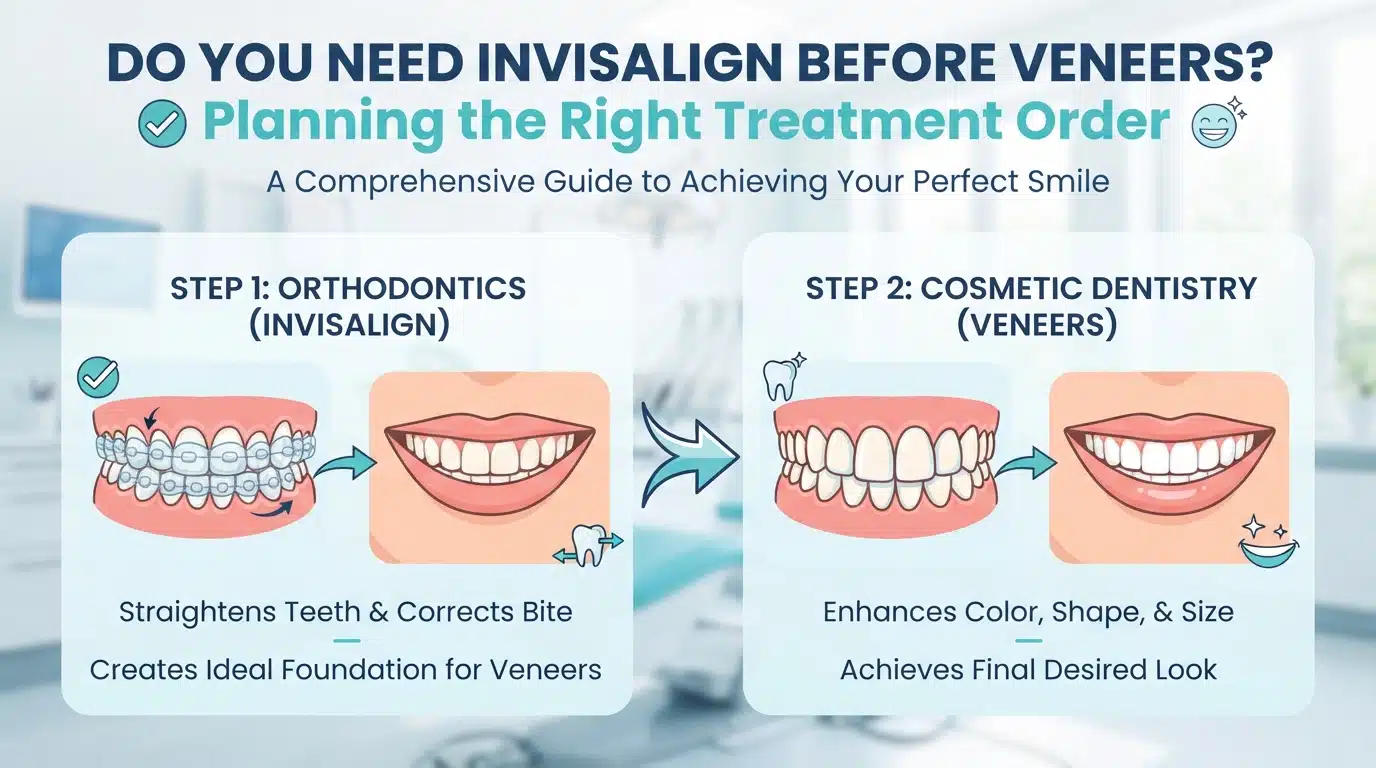
Do you need Invisalign before veneers? Not always. Whether teeth should be straightened before veneers depends on your alignment, bite, available enamel, tooth shape and the type of cosmetic change you want to achieve.
For some patients, orthodontic alignment may be discussed first because moving teeth into more favourable positions can reduce the amount of restorative change needed to achieve a planned result. For others, veneers may be considered without prior orthodontic treatment when the existing tooth positions, bite and treatment goals make that approach appropriate.
The right sequence is therefore individual. A coordinated smile makeover in Dubai assessment can help determine whether alignment, restorative treatment or a combination of approaches should be discussed first.
Short Answer: It Depends on Alignment, Bite, Enamel and Goals
Invisalign and veneers address different aspects of a smile. Orthodontic treatment is designed to move teeth and can be used to address selected alignment, spacing and bite concerns. Veneers are restorative treatments designed to change the visible appearance of selected teeth.
Because these treatments work differently, one does not automatically replace the other. When planning a cosmetic change, a dentist may consider:
- The current position of the teeth
- The degree and type of crowding or spacing
- The relationship between the upper and lower teeth
- Bite and functional considerations
- The amount and condition of enamel
- Tooth shape and size
- Existing restorations
- Gum health
- The desired aesthetic changes
The treatment sequence may affect how much restorative alteration is required later. However, having some degree of crowding or spacing does not automatically mean orthodontic treatment must come before veneers. Your dentist or orthodontist will assess the individual situation before recommending a treatment order.
What Veneers Can Change and What They Cannot Correct Predictably
Veneers may be used to change selected visible aspects of teeth. Depending on the clinical situation, they may be considered to alter:
- Tooth shape
- Visible proportions
- Selected colour concerns
- Surface appearance
- Minor differences in size
- Certain small spaces or edge irregularities
Veneers do not physically move the natural teeth into new orthodontic positions. In some situations, restorative material may be used to create the appearance of improved alignment. However, using veneers to compensate for significant tooth-position differences can require additional restorative changes and may not be the most conservative or predictable approach. The condition of the teeth and bite matters.
If a tooth is significantly rotated, crowded or positioned outside the intended smile line, changing its appearance with a veneer may involve different planning considerations than moving the tooth orthodontically.
Before proceeding with dental veneers, the dentist should assess what is causing the visible alignment concern and whether restorative treatment is addressing the underlying treatment objective appropriately.
When Orthodontic Alignment May Be Discussed First
Orthodontic treatment may be discussed before veneers when tooth position could affect the amount of restorative treatment needed.
For selected patients, Invisalign in JLT may be one orthodontic option considered as part of the treatment plan. Alignment may be discussed first when a patient has concerns such as:
- Crowding
- Spacing
- Tooth rotations
- Teeth that are positioned unevenly
- Selected bite concerns
- Tooth positions that may require substantial restorative alteration to create a desired appearance
Moving teeth first may, in selected cases, place them in positions that are more favourable for conservative restorative planning. This does not mean Invisalign is necessary before every veneer treatment.
Orthodontic suitability depends on factors including the type of tooth movement required, bite, oral health and the overall treatment objective. Your orthodontist will assess whether Invisalign or another orthodontic approach is suitable.
When Veneers Without Prior Orthodontics May Be Considered
Veneers may be considered without prior orthodontic treatment when the tooth positions and bite allow the planned cosmetic changes to be achieved through restorative treatment.
For example, the primary concern may involve:
- Tooth shape
- Small differences in tooth size
- Surface appearance
- Selected colour concerns
- Minor edge irregularities
- Cosmetic changes where significant tooth movement is not required
The fact that veneers may be considered without orthodontics does not mean they are automatically suitable.
Before treatment, the dentist may assess:
- Tooth structure
- Enamel condition
- Existing fillings or restorations
- Gum health
- Bite forces
- Tooth wear
- Oral habits
- The expected scope of cosmetic change
Veneers should not be used as a universal substitute for orthodontic treatment. A personalised assessment can clarify whether the treatment goal is better addressed through tooth movement, restorative treatment or a carefully planned combination.
Potential Advantages of Planning Alignment Before Restorations
When orthodontic treatment is appropriate, planning alignment before restorative treatment may offer several potential advantages.
It may reduce the amount of restorative alteration required
If teeth can be moved into more favourable positions, less restorative material may be needed to change their visible appearance. The amount of potential benefit depends on the original tooth positions and the planned final result.
It may improve space planning
Tooth movement may help create or redistribute space before a restorative procedure. This can be relevant when the visible proportions of teeth or spaces between them are part of the cosmetic concern.
It may allow more conservative planning for selected teeth
In some cases, improved tooth positioning may allow the restorative plan to focus on smaller changes rather than compensating for the original position of the tooth. However, this depends on the individual anatomy and treatment objective.
It can help address orthodontic and cosmetic goals separately
Orthodontics and restorative dentistry have different roles. Moving the teeth first may allow tooth position to be addressed before decisions are made about shape, colour or surface appearance.
This sequence is not automatically the right choice for everyone. Your dentist and orthodontist should consider whether the additional orthodontic stage is clinically justified for your goals.
Whitening, Bonding and Gum Care in the Treatment Sequence
Veneers and orthodontic treatment are not always the only treatments considered during smile planning.
Teeth whitening
When natural tooth colour is a major concern, professional teeth whitening may be discussed before the final shade of new cosmetic restorations is selected.
Whitening can affect the colour of natural teeth, but it does not necessarily change the colour of existing restorations in the same way. For this reason, colour planning should be discussed before new veneers or bonding are finalised.
Composite bonding
In some cases, orthodontic treatment may be followed by minor composite bonding to refine selected tooth shapes or edges. Whether this is appropriate depends on the condition and position of the teeth after alignment.
Gum care
Healthy gums are an important part of cosmetic treatment planning. Gum inflammation or other oral-health concerns may need to be assessed and managed before elective cosmetic procedures.
The appearance of the gumline can also influence how veneers and other cosmetic restorations are planned.
Why Multidisciplinary Planning Matters
When both alignment and cosmetic restoration are being considered, treatment planning may involve more than one area of dentistry. An orthodontist can assess tooth movement, alignment and bite considerations.
A restorative or cosmetic dentist can assess tooth structure, enamel, restorative options and the planned appearance of the smile. Coordinated planning may help ensure that orthodontic treatment and restorative treatment are considered in the correct sequence.
This is particularly relevant when a person has both functional and aesthetic goals. A treatment plan should not be based only on whether a particular procedure is popular or appears convenient.
The clinicians involved may need to consider:
- What changes can be achieved through tooth movement
- What changes require restorative treatment
- Whether existing restorations affect orthodontic planning
- Whether the bite requires additional assessment
- How the final appearance and function are expected to work together
You can meet our multidisciplinary dental team to understand the clinicians involved in orthodontic and restorative treatment planning.
Questions to Bring to Your Smile Consultation
If you are considering Invisalign, veneers or both, asking clear questions can help you understand the proposed treatment sequence.
You may wish to ask:
- Is my main concern caused by tooth position, tooth shape, colour or a combination?
- Could orthodontic alignment reduce the amount of restorative treatment needed?
- What would be the advantages and limitations of having veneers without orthodontic treatment?
- Does my bite affect the treatment options being considered?
- How much tooth preparation may be required for the proposed veneers?
- Are my gums and teeth healthy enough for elective cosmetic treatment?
- Should whitening be considered before the final shade of restorations is selected?
- Will the orthodontic and restorative treatment be planned together?
- How will existing fillings, crowns or veneers affect the treatment plan?
- What maintenance should I expect after the proposed treatment is completed?
The answers depend on your clinical situation. A consultation should give you the opportunity to understand the reasoning behind the proposed order rather than simply being told which treatment to choose.
Frequently Asked Questions
- Do I always need Invisalign before veneers?
No. Invisalign is not required before every veneer treatment. Whether orthodontic alignment should be considered first depends on tooth position, bite, enamel, oral health and the planned cosmetic changes. In selected cases, veneers may be considered without prior orthodontic treatment.
- Can veneers fix crooked teeth?
Veneers can change the visible appearance of selected teeth, but they do not physically move teeth into new positions. For minor visible irregularities, restorative treatment may sometimes be considered. More significant crowding, rotations or bite concerns may require orthodontic assessment. Your dentist or orthodontist will assess which approach is appropriate.
- Can I have Invisalign if I already have veneers?
In some cases, orthodontic treatment may be considered for a person who already has veneers, but treatment planning can be more complex. The condition, position and attachment of existing restorations need to be assessed before deciding whether orthodontic treatment is suitable.
- Should teeth whitening be done before veneers?
Whitening may be discussed before veneers when the colour of the natural teeth is part of the treatment goal, because the shade of new restorations may be selected in relation to the surrounding teeth. Whitening does not necessarily change the colour of existing restorations in the same way. Your dentist will assess the appropriate sequence.
- Who plans treatment when both alignment and veneers are involved?
Treatment may involve coordinated planning between an orthodontist and the dentist responsible for the restorative or cosmetic treatment. The appropriate approach depends on the complexity of the alignment, bite, tooth structure and cosmetic goals.
Coordinated Smile Planning in JLT Dubai
The decision to have Invisalign before veneers should be based on an individual assessment rather than a standard treatment sequence.
Some patients may benefit from discussing orthodontic alignment before cosmetic restorations. For others, veneers or another restorative approach may be considered without a separate orthodontic stage. In more complex cases, several treatments may need to be planned together.
If you are considering Invisalign, veneers or a combination of treatments, a personalized consultation can help clarify the order that may be appropriate for your alignment, bite, tooth structure and aesthetic goals. Your dentist or orthodontist will assess your individual situation before discussing a treatment plan.
