
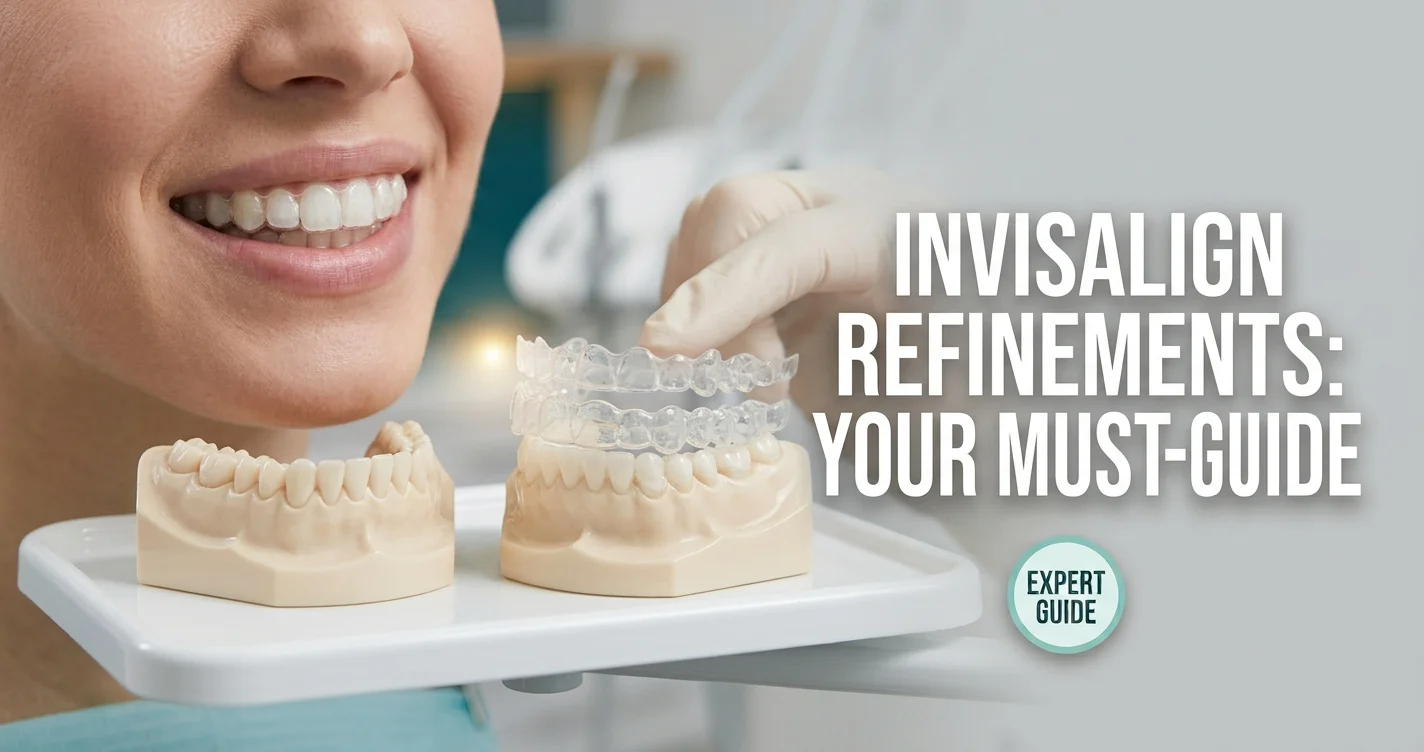
An Invisalign refinement is a further set of aligners made after your original series, or partway through, when your teeth have not moved exactly as planned. It usually follows a new scan so the orthodontist can plan the remaining movements. Refinements are a recognised part of clear aligner treatment and are not automatically a sign that something has gone wrong. Teeth do not always respond in exactly the way a digital plan predicts. How many refinements are needed, how long they take and whether they are included in your fee depend on your case and on your clinic’s terms, so it is worth asking before you begin.
Key takeaways
- A refinement means extra aligners to finish tooth movements the first series did not fully achieve.
- It is not automatically a treatment failure; research shows refinements are common in comprehensive aligner treatment.
- New scans and a revised digital plan are usually part of the process.
- Consistent wear and attending checks can influence how closely teeth follow the plan.
- Ask in advance what the package includes and how time and cost are affected.
What refinements mean
Invisalign treatment begins with a digital plan that maps tooth movement into a series of aligners. Your teeth are not machines, though, and some movements follow the plan more closely than others. When the final aligners are finished, or sooner if the fit is clearly drifting, the orthodontist may judge that further movement is needed. The additional aligners made to complete it are usually called refinements.
This is a normal part of treatment planning rather than a fault. Published research on aligner therapy describes refinement plans as used to improve the outcome after the initial sequence of aligners, and notes that several digital plans and additional aligners may be required in comprehensive treatment.
Why reassessment may be needed
Several factors can mean teeth do not track the plan exactly.
- Some movements are harder for aligners to achieve, such as rotating rounded teeth or moving teeth vertically.
- Biology varies between people. Teeth and bone respond at different speeds.
- Aligner wear that falls short of the advised hours can make teeth lag behind the plan.
- Attachments may be lost or worn, reducing grip on a tooth.
- Bite changes or dental work during treatment can alter the plan.
- Gaps or tracking issues may only become obvious later in the series.
One study of deep bite correction with Invisalign found that most of the overbite correction occurred during the first set of aligners, and that refinement treatment did not show the same level of accuracy. This is an example of how some movements are harder to predict, and why your orthodontist may talk about particular teeth rather than a general success rate.
Scans and revised treatment planning
If a refinement is advised, your orthodontist will normally take a new scan or impressions, record where your teeth are now and compare them with the plan. A revised digital plan is then prepared to move the teeth from their current positions to the intended ones. New aligners are manufactured and you move onto the new series, usually with a check at the start and regular reviews after that.
Sometimes the revised plan involves extra attachments or minor adjustments between teeth to create space. These decisions depend on the individual case, and your orthodontist can explain what applies to you. If you want to understand attachments better, our article on Invisalign attachments explains what they are for.
Patient adherence and tracking
Teeth that follow the plan well are less likely to need extensive revision. Wearing aligners for the hours advised, changing them on schedule and keeping appointments all help your orthodontist see early whether teeth are tracking. If an aligner stops fitting properly, contact the clinic rather than skipping ahead, because forcing a poorly seated aligner may not move teeth as intended.
If you have fallen behind, say so. A plan can often be adjusted earlier more easily than it can at the end, and being open protects both the timeline and the result.
Time, cost and what the package includes
There is no universal timeline for a refinement. A small finishing set may be shorter than the original series, while a complex case may need more time and more than one refinement phase. For general background on how long aligner treatment takes, see our guide to Invisalign treatment time.
Whether additional aligners are included in your fee depends on the type of treatment package and your clinic’s terms. They are not always free, and it would be wrong to assume they are. Some provider terms do allow additional aligners to be ordered for a set period, but the details vary, so ask for the policy in writing before you start. Our Invisalign page describes the general pathway, and your orthodontist can explain the specifics of your plan.
What a refinement is not
A refinement is not a restart, and it is not a signal that the earlier aligners were wasted. The movements already achieved remain part of the result, and the new series builds on them. It is also not a reason to panic about the timeline. A small finishing refinement may be focused on a single rotated tooth or a small gap, while a larger one may revisit the bite.
It is, however, a reason to ask good questions. If your orthodontist recommends one, ask which teeth have not moved as planned, what the new plan aims to achieve and what the next review point is. A clear explanation is a sign that the plan is being actively managed rather than simply extended.
Questions to ask your orthodontist
- How likely is it that my case will need refinements, and why?
- Which teeth or movements are most likely to need them?
- Are additional aligners included in my fee, and for how long?
- Will a refinement need new scans, attachments or other changes?
- How will you monitor whether my teeth are tracking?
- What should I do if an aligner no longer fits properly?
- How would a refinement affect my total treatment time?
If you are in JLT
If you are considering Invisalign, or have started and have questions about tracking, an appointment with the orthodontic team can clarify what to expect. Request a consultation and the team will confirm availability.
Frequently asked questions
Do refinements mean my Invisalign failed?
No. Refinements are a recognised part of aligner treatment and often reflect the fact that teeth do not move exactly as predicted. Your orthodontist can explain why one is advised in your case.
How many refinements will I need?
It varies. Some cases need none, some need one, and complex cases may need more. Your orthodontist can indicate how likely it is after assessing your teeth.
Are additional aligners always free?
Not always. It depends on the package and the clinic’s terms. Ask what is included, and for how long, before treatment begins.
How long does a refinement take?
There is no universal time. A small refinement may be shorter than the original series, while complex cases take longer. Your orthodontist will give an estimate after a new scan.
Can I avoid refinements by wearing aligners more strictly?
Good wear and attendance help teeth follow the plan, but some movements are hard to predict, so refinements may still be needed in some cases.
What happens at a refinement appointment?
Usually a new scan or impressions are taken, your progress is compared with the plan, and a revised plan is prepared. New aligners are then made.
This article is general patient education. It does not replace an examination or individual advice from a dentist who has assessed your teeth, gums and bite.
Sources and further reading
- Study of deep bite correction across initial and refinement Invisalign aligners (BMC Oral Health 2024; DOI 10.1186/s12903-024-04099-8; exact title not confirmed from excerpt). BMC Oral Health. https://bmcoralhealth.Biomedcentral.Com/counter/pdf/10.1186/s12903-024-04099-8.pdf
- Study of the number of digital treatment plans and aligners used in Invisalign treatment, including refinement plans (exact title not confirmed from excerpt). PubMed Central (PMC10693725). https://pmc.ncbi.nlm.nih.gov/articles/PMC10693725/
