
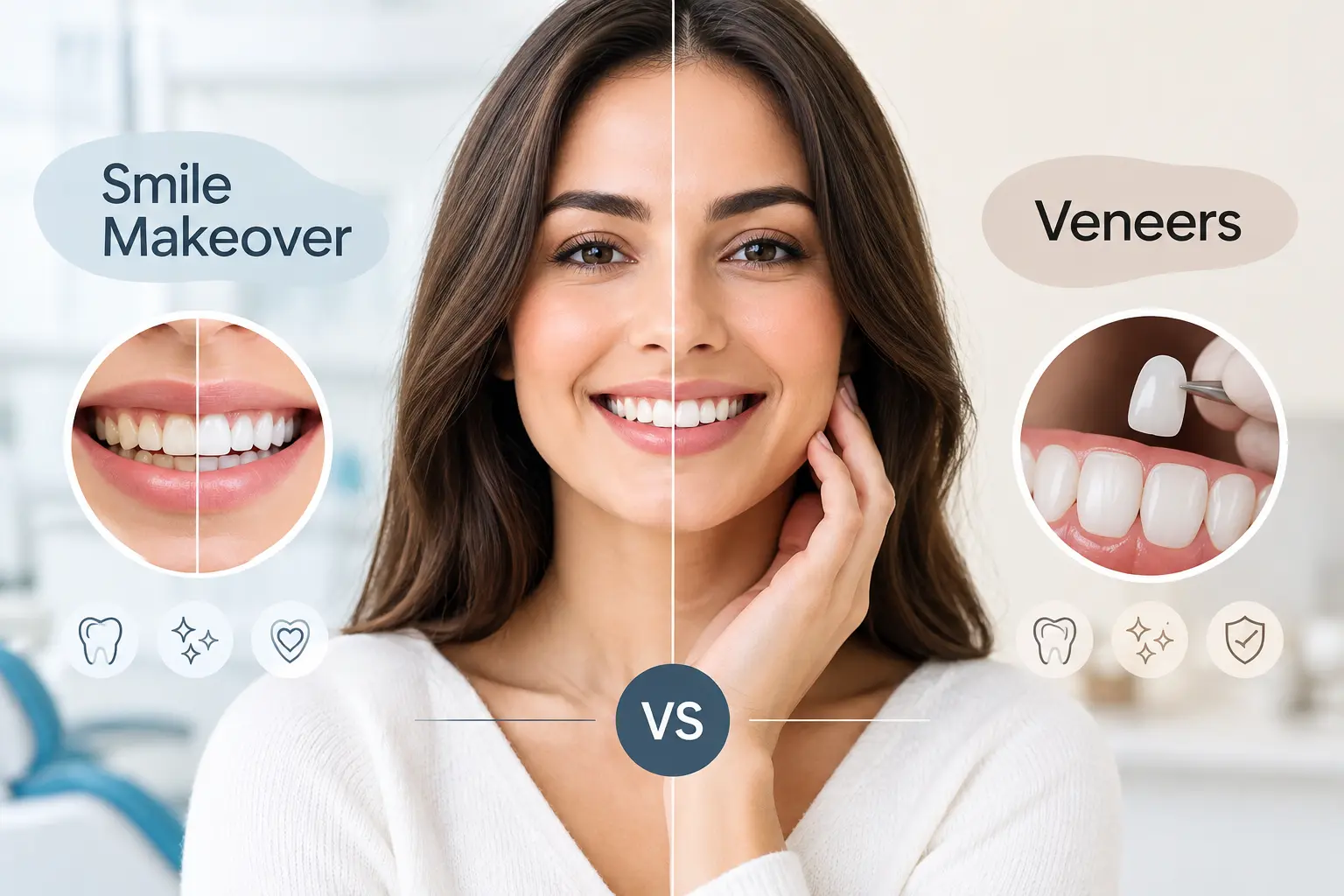
When comparing a smile makeover vs veneers, the key difference is that veneers are one possible cosmetic dental treatment, while a smile makeover is a personalized treatment plan that may involve veneers, one treatment or a combination of several approaches.
For some people, veneers may be considered as part of achieving their aesthetic goals. For others, concerns such as tooth alignment, colour, worn teeth, missing tooth structure or gum health may mean that a different sequence or combination of treatments should be discussed first.
If you are considering a smile makeover in Dubai, the aim of a consultation is not simply to choose the treatment that changes the most teeth. It is to assess your oral health, existing teeth and aesthetic goals before discussing which treatments may be appropriate.
For adults in Dubai considering cosmetic dentistry, the most useful question is often: What changes would help me reach my goals while respecting the condition and structure of my natural teeth?
Quick Answer: A Treatment Plan Versus One Possible Treatment
A veneer is a type of dental restoration used to change the visible appearance of a tooth. Veneers may be considered for selected aesthetic concerns involving factors such as tooth shape, colour or minor appearance-related differences.
A smile makeover is broader.
It refers to a personalized approach to improving the appearance of the smile. Depending on the individual assessment and goals, the treatment plan may involve one procedure or several coordinated treatments.
For example, a smile makeover may involve consideration of:
- Veneers
- Teeth whitening
- Orthodontic treatment
- Composite bonding
- Crowns or other restorations
- Gum-related treatment where clinically appropriate
Not every smile makeover includes all of these treatments, and not every patient who wants cosmetic changes needs veneers.
The treatment plan should be based on the condition of the teeth and gums, the type of aesthetic changes desired and the clinical considerations involved.
What Veneers Can Address and Their Limitations
Veneers are thin restorations that are bonded to the visible front surface of selected teeth to change their appearance.
Patients considering dental veneers in JLT may discuss veneers for concerns such as:
- Tooth colour that may not respond as desired to whitening
- Differences in tooth shape
- Minor size differences
- Small gaps or spaces in selected situations
- Certain cosmetic concerns involving the visible front surfaces of teeth
- Teeth with worn or altered appearance where veneers may be clinically appropriate
However, veneers are not a universal solution for every cosmetic concern.
The condition of the natural tooth, the bite, the amount of tooth structure available and the nature of the aesthetic concern all matter. If a patient has significant alignment concerns, active oral disease, an unstable bite or other clinical issues, placing veneers without considering these factors may not be the appropriate first step.
Veneers can also involve preparation or alteration of natural tooth structure. The amount of preparation required varies depending on the clinical situation and the type of restoration being planned.
For this reason, it would not be medically accurate to describe veneers as universally reversible. In cases where natural tooth structure is altered, the treatment has long-term restorative implications that should be discussed before proceeding.
A veneer consultation should therefore include a discussion about the proposed tooth preparation, expected appearance, limitations and ongoing maintenance.
What a Smile Makeover May Include
A smile makeover begins with the overall appearance and function of the smile rather than assuming that one procedure is suitable for everyone.
The treatment plan may consider factors such as:
- Tooth colour
- Tooth shape and proportion
- Alignment and spacing
- Existing restorations
- Gum appearance
- Tooth wear
- The relationship between the teeth and lips
- The bite and functional considerations
- The patient’s aesthetic preferences
Based on these factors, the dentist may discuss one treatment or a sequence of treatments.
Whitening
If tooth colour is the main concern and the teeth are otherwise healthy and appropriately aligned, whitening may be discussed as one option.
Whitening can also sometimes be considered before other cosmetic restorations are planned, particularly when the intended shade of surrounding natural teeth is relevant to the final aesthetic plan.
Orthodontic treatment
When tooth position or spacing is a significant part of the concern, orthodontic treatment may be discussed before cosmetic restorations.
For selected patients, Invisalign treatment or another orthodontic approach may be considered to improve tooth alignment before deciding whether further cosmetic changes are required.
Straightening the teeth first may allow the final cosmetic plan to be reassessed once tooth positions have changed.
Composite bonding
Composite bonding may be considered for selected cosmetic changes involving tooth shape, edges or small spaces.
It is a different treatment from veneers and should be discussed according to the patient’s individual dental condition and aesthetic goals.
Veneers
Veneers may form one part of a smile makeover when changing the visible appearance of selected teeth is appropriate for the overall plan.
The number of veneers considered and the teeth involved should be determined individually rather than using a standard package.
Crowns or other restorations
A tooth that requires more extensive restorative treatment may need a different approach from a veneer.
Existing tooth structure, previous restorations and the functional demands placed on the tooth can affect which type of restoration may be considered.
Gum care
The appearance of the gums can influence the overall appearance of the smile. If gum health or gum contours require attention, this may affect the sequence of elective cosmetic treatment.
The aim is not to add unnecessary procedures. It is to identify the treatments that may contribute meaningfully to the patient’s goals while maintaining appropriate attention to oral health and function.
Side-By-Side Comparison: Concerns, Scope, Planning, Reversibility and Maintenance
| Consideration | Veneers | Smile makeover |
| Basic concept | One type of cosmetic restoration | A personalised cosmetic treatment plan |
| Scope | Focuses on selected teeth receiving veneers | May involve one treatment or several coordinated treatments |
| Main concerns | May address selected concerns involving colour, shape, size or visible tooth appearance | May address multiple aspects of smile appearance depending on individual goals |
| Planning | Focuses on the teeth being restored and their relationship to the overall smile | Considers the wider smile, oral health, function and treatment sequence |
| Tooth preparation | May involve alteration of natural tooth structure depending on the case | Depends on which treatments are included |
| Reversibility | Should not be described as universally reversible, particularly where tooth structure is altered | Depends entirely on the treatments included |
| Maintenance | Requires ongoing oral hygiene, dental review and appropriate care of restorations | Depends on the combination of treatments and restorations involved |
The main trade-off is therefore between a single treatment and a broader treatment plan. Veneers may be an important part of a cosmetic result, but they do not automatically address every reason a person may be unhappy with their smile.
A smile makeover can provide a more comprehensive planning framework when multiple factors are involved. However, a broader plan does not automatically mean that more treatment is better.
For some patients, the most appropriate cosmetic plan may involve one carefully selected treatment.
When Veneers Alone May Be Considered
Veneers alone may be discussed when the main aesthetic concerns are limited to selected teeth and the dentist considers the surrounding oral conditions suitable for the proposed treatment.
For example, the discussion may involve patients whose concerns relate primarily to visible tooth colour, shape or minor appearance differences.
Before veneers are considered, the dentist may assess:
- The condition and amount of natural tooth structure
- Existing fillings, restorations or damage
- Gum health
- Tooth position
- Bite and functional relationships
- The number of teeth involved in the visible smile
- The patient’s expectations about appearance
A patient may prefer veneers because they want a relatively focused cosmetic change. However, preference alone does not determine suitability.
Your dentist will assess whether veneers may be appropriate and explain any limitations or alternative options relevant to your teeth.
When Alignment, Whitening, Bonding, Crowns or Gum Care May Come First
The order of cosmetic treatment can influence the final plan. The order of cosmetic treatment can influence the final plan. For selected patients, an orthodontics
Alignment before cosmetic restorations
If the position of the teeth is a major concern, orthodontic treatment may be considered before veneers or other cosmetic restorations. Moving teeth into a more favourable position may change the amount or type of restorative treatment required afterwards.
For selected patients, an orthodontic approach such as Invisalign may be discussed as part of the overall planning process. The decision depends on the type of alignment concern, the bite and the broader treatment objectives.
Whitening before restorative colour matching
Whitening may be discussed before certain cosmetic restorations when the desired shade of the natural teeth is part of the treatment planning process.
However, whitening does not change the colour of existing restorations. This should be considered when planning how natural teeth and restorations will appear together.
Patients exploring colour improvement can learn more about professional teeth whitening as part of a wider cosmetic dentistry discussion.
Bonding for selected cosmetic changes
Some minor shape or edge concerns may be discussed in relation to composite bonding rather than veneers. The choice depends on the tooth, the amount of change required and the clinical objectives.
Crowns for teeth requiring more extensive restoration
Veneers and crowns serve different restorative purposes. If a tooth has extensive structural loss or other restorative requirements, a crown or another treatment may be considered instead of a veneer.
The condition of each tooth should be assessed individually rather than applying one cosmetic treatment to every tooth.
Gum care before elective cosmetic work
Healthy gums are important when planning elective cosmetic dentistry. If there is active gum disease or another oral-health concern, it may need to be assessed and managed before proceeding with cosmetic treatment.
The sequence should be determined according to the patient’s individual oral health and treatment requirements.
Oral-Health Checks Before Elective Cosmetic Treatment
Cosmetic dentistry should not be planned in isolation from oral health. Before elective aesthetic treatment, the dentist may assess the teeth, gums, bite and existing restorations.
The assessment may identify concerns that need attention before cosmetic treatment is planned, such as:
- Active tooth decay
- Gum disease or inflammation
- Problems involving existing restorations
- Tooth wear
- Bite-related concerns
- Structural damage
Addressing these issues may affect the order in which cosmetic treatment is carried out. This does not mean that every patient will require additional treatment before improving their smile. It means the condition of the mouth should be assessed before an elective aesthetic procedure is selected.
A good cosmetic treatment discussion should consider both how the result may look and how the proposed treatment fits with the health and function of the teeth.
How to Explain Your Aesthetic Goals at a JLT Consultation
You do not need to know which treatment you want before attending a cosmetic consultation. In fact, it can be more helpful to explain what you would like to change rather than arriving with a fixed treatment request.
You may wish to discuss questions such as:
- Which aspects of my smile would I like to change?
- Is my main concern colour, shape, spacing or alignment?
- Are there particular teeth that concern me?
- Do I prefer subtle changes or a more noticeable change?
- How important is preserving natural tooth structure to my decision?
- Do I have existing restorations that may affect the plan?
- Are there treatments that may need to happen before veneers or other cosmetic work?
You can also bring examples of smile styles you like as a communication tool. However, another person’s smile should not be treated as a template that can necessarily be reproduced. Facial features, natural tooth shape, gum display, tooth proportions and existing oral conditions differ from person to person.
The purpose of sharing examples is to help the dentist understand your preferences and discuss what may be realistically appropriate for your own teeth.
Patients can meet our dentists and learn more about the Dental Oasis team when considering a personalised cosmetic treatment discussion.
Frequently Asked Questions
- Are veneers the same as a smile makeover?
No. Veneers are one type of dental restoration that may be used to change the appearance of selected teeth. A smile makeover is a personalized treatment plan that may include veneers, one different treatment or a combination of treatments depending on the patient’s oral health, teeth and aesthetic goals.
- Can a smile makeover be completed without veneers?
Yes. A smile makeover may be planned without veneers. Depending on the individual assessment and aesthetic goals, the plan may involve treatments such as whitening, orthodontic treatment, composite bonding, restorative treatment or other appropriate dental care. Not every smile makeover requires the same treatments.
- Should teeth be straightened before veneers?
In selected cases, orthodontic treatment may be considered before veneers when tooth alignment or spacing is a significant concern. Moving teeth first can change the restorative requirements and may influence the final cosmetic plan. However, the appropriate sequence depends on the individual assessment, bite, tooth position and aesthetic goals.
- Are veneers reversible?
Veneers should not be described as universally reversible. Depending on the treatment plan, preparation of the natural tooth may be required before a veneer is placed. When natural tooth structure has been altered, there can be long-term restorative implications. Your dentist should explain the proposed preparation and treatment considerations before you decide.
- How does a dentist decide which treatments belong in a smile makeover?
The dentist assesses the condition of the teeth and gums, tooth position, bite, existing restorations and the patient’s aesthetic goals. The treatment plan may include one procedure or several coordinated treatments. The final approach depends on the individual assessment rather than a standard list of cosmetic procedures.
Plan a Personalized Smile Assessment
Choosing between a smile makeover and veneers does not require you to decide on a treatment before you understand your options.
Veneers may be suitable for selected aesthetic goals, while a broader smile makeover may involve one treatment or a carefully planned combination of treatments. The appropriate approach depends on your teeth, gums, bite, existing dental work and the changes you would like to discuss.
A personalised assessment can help you discuss your aesthetic goals and understand which treatment options may be relevant to your individual situation. Your dentist can assess your oral health and existing teeth before explaining whether veneers, another treatment or a broader smile plan may be appropriate.
