
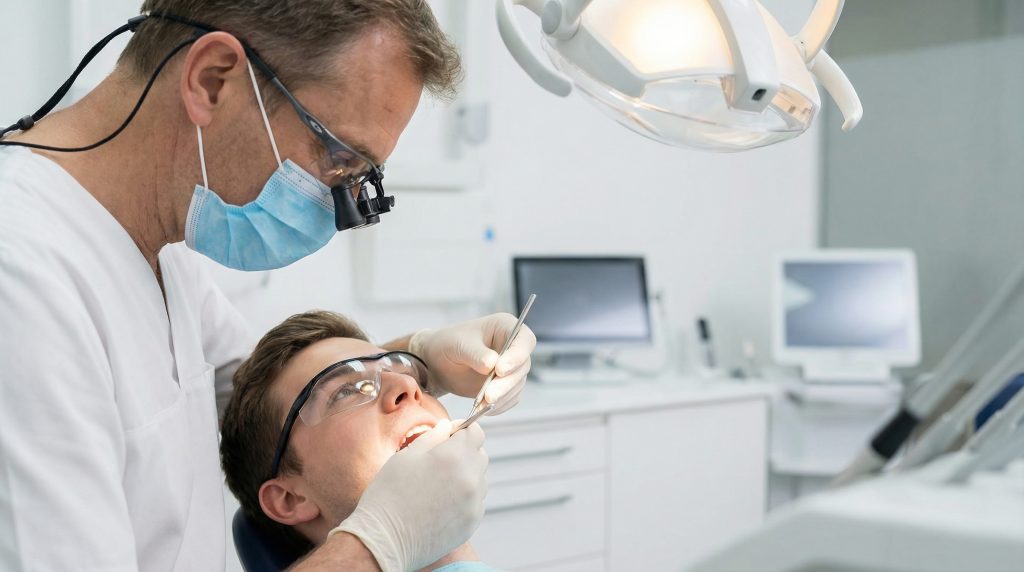
Say the words dental surgery out loud to someone and watch their face change. It’s almost instant. The mind jumps straight to worst-case scenarios, usually pieced together from a movie scene or someone else’s bad story from years ago.
A study conducted at Dubai Dental Clinics found something worth sitting with. Ninety five percent of patients surveyed named tooth extraction and dental surgery as their biggest source of anxiety, ahead of injections, ahead of drilling, ahead of basically everything else. That’s not a small number.
Here’s the thing though. Most of that fear comes from not knowing what’s actually going to happen. So let’s fix that. Here’s the real process, step by step, for the procedures people worry about most.
Before Anything Starts: The Assessment
assessment, not a scalpel.
Your dentist takes X-rays or a 3D scan first. That’s how they see what’s happening underneath, whether it’s an impacted tooth, thinning bone before an implant, or how much damage there actually is. Then comes a conversation. Your medical history. Any medications. What sedation actually makes sense for you specifically, not just what’s offered by default.
Nothing gets scheduled until that conversation happens. If a clinic skips straight to booking you in without asking any of this, that’s worth noticing.
What Actually Happens During a Tooth Extraction
Extractions happen more than any other type of dental surgery, and honestly, they’re usually the least dramatic.
Here’s roughly how it goes:
- Local anesthesia numbs the area completely first
- The dentist loosens the tooth with specific instruments
- The tooth comes out, sometimes whole, sometimes in sections if it’s deeply rooted
- Gauze goes in to control bleeding and help a clot form
- You get sent home with clear aftercare instructions
Most simple extractions wrap up in fifteen to thirty minutes. Wisdom teeth, especially impacted ones, take longer and sometimes need a small incision in the gum. Not scary. Just more involved.
Bone Grafts: Why They’re Sometimes Necessary
People hear bone graft and picture something out of a medical drama. In practice, it’s usually much less intense.
You typically need this before an implant if your jawbone has thinned in that spot, which happens a lot when a tooth’s been missing for a while. Graft material gets placed where it’s needed, then it slowly fuses with your existing bone over the following months. That healing period is what determines when the next step, usually an implant, can safely happen.
Discomfort afterward tends to be manageable with prescribed pain relief. Nothing most people can’t handle.
Dental Implant Surgery, Explained Simply
Dental implant surgery replaces a missing tooth root with a small titanium post, which eventually fuses with your jawbone to support a replacement tooth.
The process typically happens in stages:
| Stage | What Happens |
| Initial placement | The implant post is surgically placed into the jawbone |
| Healing period | Bone fuses around the implant, usually over 3 to 6 months |
| Abutment placement | A small connector piece is attached once healing is confirmed |
| Final restoration | The crown or replacement tooth is fitted on top |
Here’s what surprises people. The actual surgery is usually the shortest part. It’s the healing time in between stages that stretches things out to months instead of weeks.
Sedation and Pain Management Options
This is what people actually care about, and fair enough. Local anesthesia numbs whatever area is being treated, and that’s used in nearly every procedure without exception. For anything more involved, or if you’re just someone who gets anxious, additional sedation options usually exist too. These get discussed during your consultation. Not assumed. Not defaulted into. Discussed.
If dental anxiety is the reason, you’ve avoided treatment until now, say that out loud during your consultation. A good oral surgery team builds your comfort into the actual plan. It shouldn’t be something you have to ask for separately.
What Recovery Actually Looks Like
Recovery depends on what you had done, but some things stay pretty consistent across the board. Expect some swelling and mild discomfort for the first 48 to 72 hours. That’s normal, not a red flag. Soft foods for a few days. And genuinely, following your dentist’s aftercare instructions matters more than most people give it credit for. It’s the difference between smooth healing and an unnecessary setback.
Simple procedures usually mean back to normal within a few days. More involved surgery, bone grafts, implants, that’s more like a week or two before things feel routine again.
Why Understanding the Process Actually Helps
Fear shrinks once you actually know what’s coming. That’s it. That’s the whole point of this article. Knowing roughly what each stage involves, how long it takes, what recovery actually feels like, removes a lot of the anxiety that keeps people putting off treatment they genuinely need.
If you’ve been avoiding a procedure because you weren’t sure what to expect, book a consultation and get a straight, honest walkthrough of your specific situation before you decide anything.
Key Takeaways
- Every dental surgery starts with a proper assessment first, X-rays or scans included, before anything gets scheduled.
- Sedation and pain management get discussed with you directly. They’re not assumed on your behalf.
- Recovery time varies by procedure, but following aftercare instructions is what actually affects how smoothly you heal.
FAQ
Q: Is dental surgery in Dubai painful?
A: For almost all procedures, local anesthesia is used to numb the treatment area, and other methods of sedation are available for more complex treatments. During recovery, some level of discomfort is expected, but this is usually treated with prescribed pain medications.
Q: How long does recovery take after dental surgery?
A: It depends on the activities you have carried out. Simple extractions typically heal in a matter of days. You’ll typically be able to resume daily activities sooner than bone grafts and implants are fully healed (which can take weeks to months).
Q: Do I need a bone graft before getting an implant?
A: Not always. This depends on the amount of bone density that is left in the area. Your dentist will be able to determine this from an X-ray or scan taken in your initial checkup.
Q: What if I have severe dental anxiety about surgery?
A: Mention this during your consultation. Sedation options and a slower, more communicative approach can be built into your treatment plan so the procedure feels manageable rather than overwhelming.

На этом ресурсе есть шанс почерпнуть важную информацию.
https://e-transavto.ru/read/snizhenie-covid-19-v-voronezhskoy-oblasti-tsifry-tendentsii-vyvody-285/
Свадебная церемония становится ключевым событием в жизни людей.
Данный день означает образование общей истории.
Он соединяет этих любящих людей перед родными и гостями.
https://sxteh.ru/svadba-zimoj-idei-sovety-i-rekomendaczii.html
Церемония помогает паре открыто признаться в своих чувствах и обменяться клятвами.
Торжество является памятью на долгие годы, поддерживая союз супругов.
На данном ресурсе есть возможность получить много ценных сведений.
https://spacefan.breakmoda.ru/oIBEaEGST3oN/