
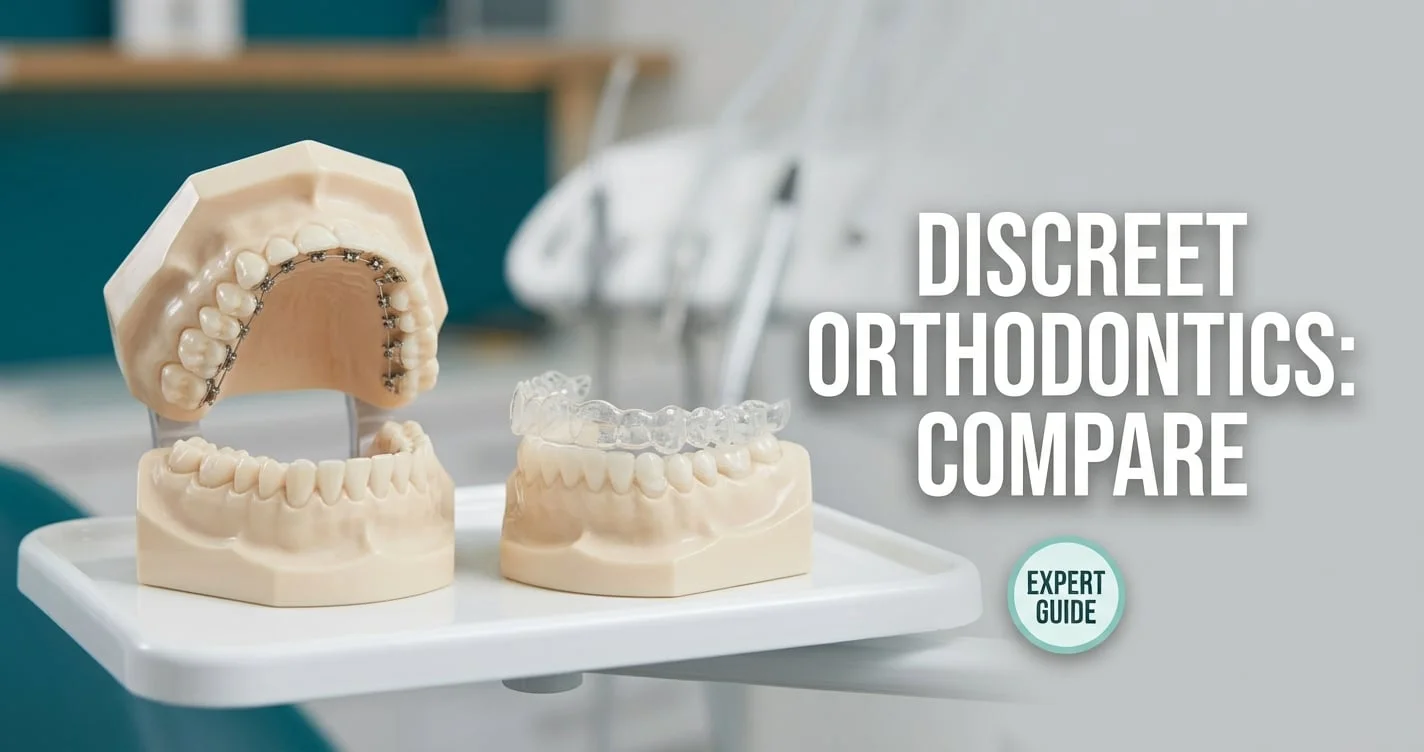
Lingual braces and Invisalign are both discreet, but they are very different appliances. Lingual braces are fixed brackets bonded to the tongue-side of the teeth, so they are hidden from view and work continuously. Invisalign uses clear, removable aligners that are worn for the hours your orthodontist specifies. Lingual braces tend to affect speech and tongue comfort more at first, while aligners rely on your wearing them consistently. Which suits you depends on your teeth, bite, routine and tolerance for adapting, and needs specialist assessment. This guide compares the practical points side by side.
Key takeaways
- Lingual braces are fixed behind the teeth; Invisalign aligners are removable and clear.
- Reviews of research report more speech difficulty with lingual braces than with braces on the front surfaces.
- Both options need good cleaning, but the routines are different.
- Aligners depend on consistent wear; lingual braces do not.
- Not every bite or tooth movement suits both, and lingual braces call for a clinician with relevant training.
Appliance position and visibility
Lingual braces are bonded to the inner surfaces of the teeth, facing the tongue. From the front, they are largely hidden. Some systems use brackets made to fit your teeth individually, while others use standard brackets, and your orthodontist will explain which is proposed. Details are on our lingual braces service page.
Invisalign aligners are thin, clear plastic trays that fit over the teeth. They are noticeable up close, especially when shiny, and some treatments use small tooth-coloured attachments on the teeth to help the aligners move them. Whether attachments are needed depends on the plan. You can read more in our guide to the clear aligner treatment pathway.
Speech adjustment and comfort
The tongue constantly touches the inner surfaces of the teeth, so putting brackets there is a change. A systematic review of research found that lingual treatment increased the likelihood of speech difficulty compared with braces on the outer surface. Another review reported that discomfort seemed similar overall, but that tongue irritation was more common and the location of soreness differed. Most people adapt over time, though how quickly varies, and individually made brackets may feel better than ready-made ones.
Aligners can also cause temporary speech changes for some people, as many appliances can, but they are removable, and the effect often settles as you adapt. If you present, teach or speak on the phone for a living, ask your orthodontist how long adjustment is likely to take for each option, and whether they have seen it settle in similar patients.
Cleaning and eating
Lingual braces sit where the tongue and saliva flow, but they are harder to see and reach with a toothbrush. Oral hygiene needs close attention. Research has not been able to show a clear difference in caries between lingual and conventional braces, though patients with lingual braces often find cleaning more difficult. Our article on looking after lingual braces covers routine care, although the focus of this article is on the comparison with aligners.
With Invisalign you remove the aligners for meals, so eating is less restricted, but you should brush before putting them back and keep them clean. With lingual braces you eat with the appliance in place, so you need to avoid foods that may break brackets and clean carefully afterwards.
Compliance
Compliance is a major difference. Aligners only work when they are worn, and the plan assumes you keep to the hours advised. If your daily routine makes this difficult, lingual braces can be more reliable because they are fixed. If you are well organised, aligners can fit around meals and social events. You can read more about how aligner treatment is paced in our article on Invisalign compared with braces for adults.
Suitability and specialist assessment
Lingual orthodontics is a specialised technique. Not every orthodontist offers it, and it takes training and experience to plan and manage. Dr. Sandesh Baralay’s clinic profile lists training in lingual orthodontics, but you should always ask your clinician about their experience with the specific system proposed for you.
Your orthodontist will consider the same questions as for any braces: crowding and spacing, bite, tooth shape, gum health and the planned movements. Short or small teeth can be harder to bond lingually, and some bite problems or complex movements may be more predictable with one appliance than the other. The evidence base for lingual appliances, according to a review, is limited, so decisions rely on clinical judgement as well as published research.
Individual treatment and cost factors
Cost reflects the appliance, the complexity of the case, the length of treatment, laboratory work for custom brackets or aligners, and the follow-up included. Lingual systems often involve more specialised planning and chair time, while aligners may involve a series of trays and scans, but neither assumption applies to every case. Ask for an explanation of what is included rather than comparing headline numbers.
Balanced comparison
| Factor | Lingual braces | Invisalign aligners |
| Position | Fixed, behind the teeth | Removable, over the teeth |
| Visibility | Largely hidden from the front | Clear but visible up close |
| Speech | More reported difficulty at first | Temporary changes can occur |
| Tongue comfort | Tongue irritation more common | Edges can rub in some people |
| Eating | Eat with braces in; avoid hard foods | Remove for meals |
| Cleaning | Harder to reach; needs close attention | Clean teeth and aligners |
| Compliance | Not dependent on wear | Depends on wearing as directed |
| Specialist input | Needs relevant training | Needs careful planning and review |
Who tends to choose which
People who speak a lot at work or who are wary of any change to speech sometimes lean towards aligners, while people who prefer a fixed appliance that does not depend on daily habits may choose lingual braces. Others decide on appearance alone or on what their orthodontist recommends. Whatever your starting preference, ask your orthodontist to show you how each option would handle your specific tooth movements.
Questions for your consultation
- Are my teeth and bite suitable for lingual braces, aligners or both?
- What is your experience with the specific lingual system you propose?
- How long do patients usually take to adapt to speaking with each option?
- Will my brackets be custom-made or standard?
- How many hours a day must aligners be worn, and how is progress checked?
- What does the fee include, and what could add to it?
- What retainers will I need afterwards?
Arranging an assessment in JLT
If discretion is your priority, a specialist assessment can show which option your teeth allow. You can ask Dental Oasis for a consultation and the team will confirm availability.
Frequently asked questions
Are lingual braces completely invisible?
They are hidden from the front in normal view, but they are not invisible in every situation, and the tongue and lips may reveal them in some angles. Your orthodontist can show you what to expect.
Do lingual braces affect speech more than Invisalign?
Research reports more speech difficulty with lingual braces than with braces on the outer surface. Aligners can also change speech temporarily. Adaptation time varies from person to person.
Which is more comfortable?
Neither is universally more comfortable. Lingual braces can irritate the tongue, while aligners can cause pressure and rubbing at the edges. Ask your orthodontist what to expect with your teeth.
Can anyone have lingual braces or Invisalign?
No. Suitability depends on your teeth, gums, bite and the planned movements, so a specialist assessment is needed to find out which options are appropriate.
Is Invisalign or lingual faster?
There is no guarantee for either. Treatment time depends on the complexity of the case and, for aligners, how consistently they are worn.
What will it cost?
It depends on your individual plan and what the fee includes. A consultation is needed for a real estimate.
This article is general patient education. It does not replace an examination or individual advice from a dentist who has assessed your teeth, gums and bite.
Sources and further reading
- Comparison of adverse effects between lingual and labial orthodontic treatment: a systematic review (Angle Orthod 2013;83(6):1066-1073). The Angle Orthodontist. https://pmc.ncbi.nlm.nih.gov/articles/PMC8722844
- Lingual orthodontic treatment: what is the current evidence base? (J Orthod 2013). Journal of Orthodontics. https://pubmed.ncbi.nlm.nih.gov/24005948/
- Impact of orthodontic treatment on speech and phonetics: a review. Int J Community Med Public Health. https://www.ijcmph.com/index.php/ijcmph/article/view/11568
