
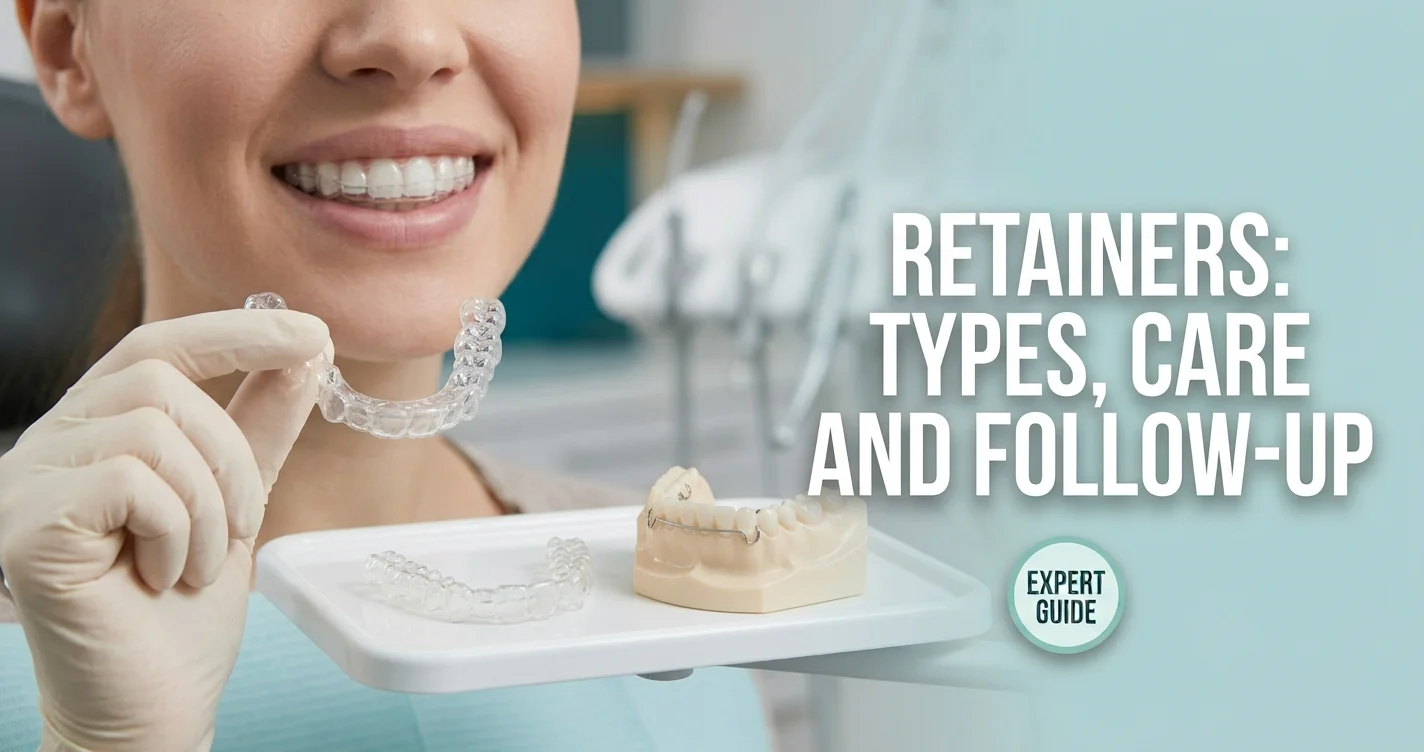
Retainers are worn after braces or Invisalign to help keep your teeth where they have been moved. Teeth tend to drift back towards their old positions, and they can also shift gradually as we age, so almost every patient who has had orthodontic treatment is advised to wear retainers. They can be fixed, bonded behind the teeth, or removable, such as clear plastic or wire-and-acrylic types. Your orthodontist decides which type suits you and gives wear instructions for your case. This article explains the types, how to care for them and when to contact your orthodontist.
Key takeaways
- Retainers are advised in almost all cases because teeth tend to move back after treatment.
- Fixed retainers stay in; removable retainers must be worn and looked after.
- Wear instructions are individual; follow your orthodontist’s schedule rather than a general rule.
- Cleaning needs differ by type, and fixed retainers need extra care around the wire.
- Do not force a retainer that does not fit; contact your orthodontist.
Why retention matters
The British Orthodontic Society gives two reasons for wearing retainers. First, teeth tend to want to return towards their original positions, which is called relapse. Second, teeth can shift unpredictably as we get older, sometimes showing more crowding or overlapping. Wearing retainers long term helps reduce those changes, and the society notes that the longer you wear them, the longer you can keep your teeth straight.
Retainers do not straighten teeth. They cannot apply the steady force needed to move them, which is why they are used after active treatment has finished. If you are starting treatment, it is worth treating retainers as part of the plan rather than an afterthought. Our articles on self-ligating braces treatment stages and Invisalign treatment time describe where retention fits.
Fixed and removable retainers
Retainers fall into two groups. Fixed retainers are bonded to the teeth, usually on the inner surface of the lower front teeth, so they cannot be removed by the patient. Removable retainers can be taken out for eating and cleaning. Several types are used. Clear vacuum-formed retainers, also known as Essix retainers, are moulded plastic trays. Hawley retainers combine a plastic or acrylic part with a wire across the front teeth. Sometimes more than one type is recommended together.
| Type | How it works | Points to consider |
| Fixed (bonded) | Wire bonded behind teeth | No need to remember to wear it; needs extra cleaning and a check if it loosens |
| Clear removable (Essix) | Moulded clear plastic tray | Usually worn part-time; never eat or drink with it in; can be lost or damaged |
| Hawley | Plastic or acrylic with wire | Strong and removable; may affect speech slightly at first |
The choice depends on factors such as your original problem, the teeth involved, your habits and your preferences. You can read more on our retainers service page.
Individual wear instructions
There is no single schedule that suits everyone. Some patients wear removable retainers full time for an initial period and then move to part-time wear, while others follow a different pattern. Your orthodontist will tell you how often and for how long to wear yours, and the instructions help to reduce relapse and avoid damage to teeth and gums. Treat any online schedule with caution, because it was not written for your mouth.
If you are unsure what you were told, ask for it in writing at your next visit. It is easier to correct a misunderstanding early than after teeth have moved.
Cleaning and follow-up
Removable retainers should be cleaned regularly. Typical guidance is to brush them gently with a soft brush and mild soap and water, though you should follow your orthodontist’s instructions because heat and some cleaners can damage plastic. Keep them in a case when they are not in your mouth, and away from pets and pockets.
Fixed retainers need extra attention because food and plaque can build up around the wire. You can floss around a fixed retainer using the technique your clinic shows you. If a bonded retainer comes loose or feels rough, seek advice promptly. Routine dental visits, including professional cleaning, are important for checking it.
Orthodontic follow-up after treatment usually includes a review of how the teeth are holding. Attend these reviews and tell your clinic if you notice any change in your bite or alignment.
Lost, damaged or poorly fitting retainers
Retainers get lost, snapped and left in napkins. If this happens, contact your orthodontist as soon as possible. Waiting can allow teeth to drift, and a retainer made for the original positions may no longer fit well. A replacement may need a new scan or impression.
If your retainer feels tight after a gap in wear, do not force it into place. Forcing it can damage the retainer or put unplanned pressure on your teeth. Stop, keep it safe and contact your orthodontist so they can check the fit and advise.
Retainers and everyday life
Retainers should fit into your routine, not be a daily fight. Keep a case in your bag and by the bed so a removable retainer is never wrapped in a tissue. Remove it for meals and sports as directed, and put it back after brushing. If you travel, pack a spare case and your orthodontist’s contact details. If you know you will struggle with a removable retainer, tell your orthodontist, because a fixed retainer, or a combination, may suit you better.
Mention your retainers when you see a general dentist or hygienist, too. A fixed wire can make scaling around the lower front teeth a little different, and your dental team will want to check it as part of routine reviews.
When to contact the orthodontist
- A fixed retainer feels loose, has a sharp edge or has come away from a tooth.
- A removable retainer is cracked, bent or no longer fits comfortably.
- You notice teeth shifting or your bite feeling different.
- You have been told to wear a retainer and have a long gap in wear.
- Your gums are sore, swollen or bleeding around a fixed retainer.
- You have lost a retainer.
If you are in JLT
If you are nearing the end of treatment, or need a replacement or review, you can contact Dental Oasis and the team will advise on appointments.
Frequently asked questions
Do I need retainers after Invisalign as well as braces?
Yes, retainers are usually advised after both, because teeth can move back after any orthodontic treatment. Your orthodontist will recommend a type and wear schedule.
Are fixed retainers better than removable ones?
Not in every case. Fixed retainers do not depend on you remembering to wear them but need careful cleaning. Removable retainers are easier to clean but rely on consistent wear. Your orthodontist will recommend what suits you.
How long do I have to wear my retainer?
It varies. Many patients are advised to wear retainers long term, but the schedule is set by your orthodontist for your case.
Can I eat with my retainer in?
Not with removable clear retainers. Guidance for vacuum-formed retainers is never to eat or drink with them in place. Fixed retainers stay in, so you eat as normal and clean carefully.
What should I do if my retainer does not fit?
Do not force it. Contact your orthodontist, who can check whether your teeth have moved or the retainer is damaged.
What if I lose my retainer?
Contact your orthodontist as soon as possible. A replacement may require a new scan, and delay may allow teeth to move.
This article is general patient education. It does not replace an examination or individual advice from a dentist who has assessed your teeth, gums and bite.
Sources and further reading
- BOS (British Orthodontic Society): Retainers. British Orthodontic Society. https://archive.bos.org.uk/BOS-Homepage/Orthodontics-for-Children-Teens/Treatment-brace-types/Retainers
- Teeth Retainers. Cleveland Clinic. https://my.clevelandclinic.org/health/treatments/10899-teeth-retainer
