
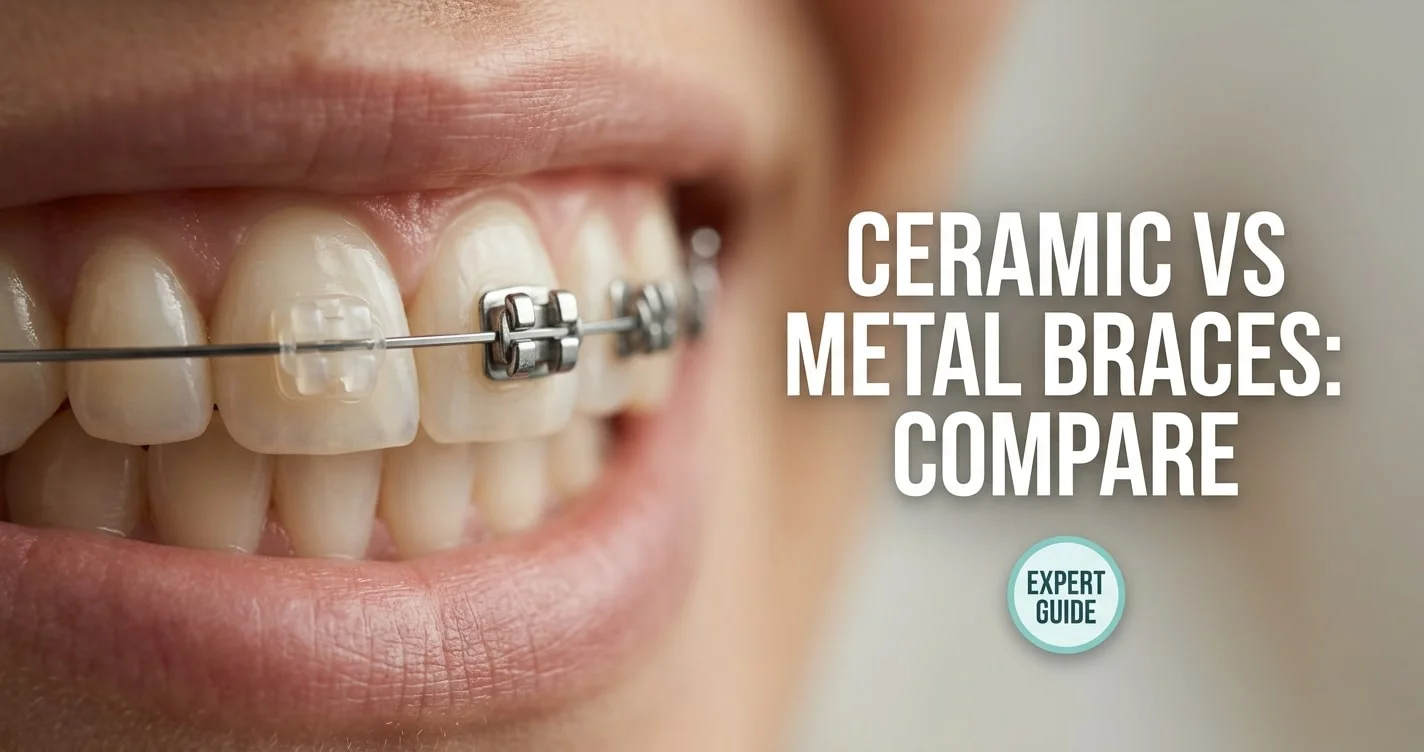
The main difference between ceramic and metal self-ligating braces is the bracket material. Ceramic brackets are tooth-coloured or translucent, so they are usually less noticeable. Metal brackets are visible but are generally more robust. Both hold the archwire with a built-in clip rather than elastic ties. Neither material is better for everyone, and neither has been shown to guarantee faster treatment. The right choice depends on your bite, the planned tooth movement, your priorities and what your orthodontist considers practical. This guide explains the trade-offs so you can ask better questions in your consultation.
Key takeaways
- Ceramic brackets are chosen mainly for appearance; metal brackets are chosen for strength and simplicity.
- Research does not show that either material, or self-ligation itself, guarantees faster treatment.
- Ceramic brackets are more brittle than metal, and removal needs particular care.
- Staining depends on more than bracket material, including diet, plaque control and other components of the system.
- Your orthodontist decides whether either option suits your teeth and bite.
What the two bracket types have in common
Self-ligating braces use brackets with a built-in clip or sliding mechanism to hold the archwire, instead of the elastic or metal ties used with conventional braces. The treatment stages, review appointments and retainers afterwards are broadly the same whichever bracket material is used. The self-ligating braces page describes the stages from consultation to retention.
What changes is the material of the bracket, which affects how visible it is, how it behaves under biting forces and how it is removed at the end of treatment.
Bracket material and appearance
Metal brackets are made of stainless steel and are clearly visible. Ceramic brackets are tooth-coloured or translucent and blend in more with the teeth. For many adults who are in client-facing work or simply self-conscious about braces, this is the deciding factor.
Appearance is not only about the bracket. The archwire is still visible, and the overall look also depends on how clean the teeth are and how the lips sit over the braces. A bracket that looks discreet on day one can look less so if plaque builds up around it.
Maintenance and staining
Ceramic brackets are generally described as resistant to staining compared with older plastic designs. That does not mean a ceramic system stays pristine on its own. Diet, smoking, plaque and the other parts of the appliance can affect how the braces look over months of treatment. Ask your orthodontist which components of your chosen system are tooth-coloured and which are metal.
Cleaning needs are similar for both. Brush carefully around each bracket, clean between teeth with the tools your orthodontist recommends, and keep regular review appointments. Our guide to cleaning self-ligating braces sets out a practical routine.
Clinical suitability and practical trade-offs
Ceramic brackets are harder and more brittle than metal. Laboratory studies and reviews have reported a higher risk of bracket fracture and a greater risk of enamel damage when ceramic brackets are removed, which is why orthodontists use careful debonding techniques. This is a reason to discuss material choice rather than a reason to avoid ceramic, because outcomes depend on the clinician, the technique and the individual tooth.
Other practical points to discuss include how bulky the bracket is, whether it may rub against the opposing teeth if your bite is deep, and whether the brackets are well suited to the teeth that need the most movement. Some bites make it sensible to use metal on certain teeth, and your orthodontist may recommend a combination.
One point is worth stressing because marketing often blurs it. Self-ligating brackets, whether metal or ceramic, have not been shown in reviews of clinical trials to deliver clearly faster or more comfortable treatment than conventional brackets. Treat any promise of shorter treatment time with caution, and ask what your plan is based on.
Individual cost factors
Fees are set for the whole treatment plan, not the bracket alone. Factors that may affect the overall cost include the complexity of the bite and alignment, planned duration, the bracket system selected, diagnostic records, retainers and any dental work needed first. Our overview of what affects self-ligating braces pricing explains these in more detail. A consultation is the only reliable way to find out how the material you choose affects your plan.
Comparison table
| Consideration | Ceramic self-ligating | Metal self-ligating |
| Visibility | Tooth-coloured or translucent | Metallic and more visible |
| Strength | More brittle; care needed at removal | Generally more robust |
| Staining | Bracket resists staining; other parts and plaque still matter | Not applicable to bracket colour; plaque still matters |
| Cleaning | Same careful routine | Same careful routine |
| Speed of treatment | No guarantee | No guarantee |
| Cost | Depends on the plan | Depends on the plan |
| Suitability | Individual assessment | Individual assessment |
Who tends to lean towards which option
People who prioritise discretion, for example because they present or meet clients often, may lean towards ceramic and accept the extra care it needs. People who play contact sports, grind their teeth or know they are heavy on appliances may prefer metal for its durability. Others choose by cost, comfort or the advice of their orthodontist alone. None of these is a wrong reason, but each should be tested against what your teeth actually need.
It also helps to think about the whole timeline. Braces are worn for many months, so a decision made for the first week should still make sense in the middle and at removal. Asking your orthodontist how each option behaves across the full treatment, including the end, gives a more realistic picture than comparing photographs.
If you already have veneers, crowns or large fillings on the front teeth, mention them early. Existing restorations can affect where brackets are placed and which materials bond reliably, and this can narrow or widen your options.
Consultation decision checklist
- How important is a discreet appearance compared with durability for me?
- Do my bite and tooth positions suit ceramic brackets on all teeth, or only some?
- Which parts of the appliance will be visible, and which will blend in?
- How are ceramic brackets removed, and what steps reduce risk to my enamel?
- What happens if a bracket breaks, and how does this affect the plan?
- What does the fee include, and does it change with bracket material?
- What retainer plan will follow treatment?
Next step in JLT
If you are comparing bracket types, an orthodontic assessment at Dental Oasis can show which options suit your case. Bring your questions and request a consultation for the team to confirm availability.
Frequently asked questions
Are ceramic braces better than metal ones?
Not in every case. Ceramic is chosen mainly for appearance, while metal is generally more robust. Which is better depends on your bite, tooth movements and priorities.
Do ceramic self-ligating braces stain?
The bracket material is generally described as stain-resistant, but plaque, diet and other parts of the appliance can still affect how braces look. Good cleaning and regular reviews help.
Does either material make treatment faster?
No material has been shown to guarantee faster treatment. Duration is more closely linked to the complexity of your case and following the plan.
Are ceramic brackets more likely to break?
Ceramic is more brittle than metal and has a higher reported fracture risk, and it needs careful removal. Your orthodontist can explain how this applies to your case.
Can I have ceramic on some teeth and metal on others?
Sometimes. Some orthodontists combine materials depending on the bite and which teeth need the most force. Ask whether this is appropriate for you.
How do I find out the cost difference?
Fees depend on your whole treatment plan, so a consultation is needed. Ask whether bracket material changes the fee and what the plan includes.
This article is general patient education. It does not replace an examination or individual advice from a dentist who has assessed your teeth, gums and bite.
Sources and further reading
- Self-ligating brackets versus conventional pre-adjusted edgewise brackets for treating malocclusion (Cochrane protocol). Cochrane Database of Systematic Reviews. https://cochranelibrary.com/cdsr/doi/10.1002/14651858.CD012407
- Transversal changes, space closure, and efficiency of conventional and self-ligating appliances: a quantitative systematic review (J Orofac Orthop 2018;79(1):1-10). Journal of Orofacial Orthopedics. https://pubmed.ncbi.nlm.nih.gov/29101414/
- Self-Ligating Versus Conventional Orthodontic Brackets: A Review of Treatment Efficiency and Adverse Effects (2026). University of Münster e-journal (DOI 10.17879/aods-2026-9145). https://ejournals.uni-muenster.de/aods/article/view/9145
- Enamel Cracks and Ceramic Bracket Failure during Debonding In Vitro (Angle Orthod 2008;78(6):1078). The Angle Orthodontist. https://angle-orthodontist.kglmeridian.com/downloadpdf/view/journals/angl/78/6/article-p1078.pdf
- Examination of Damage on Enamel Surface Due to Removal of Metal and Ceramic Brackets: A Review (Eur Ann Dent Sci 2021;48(3):129-134). European Annals of Dental Sciences. https://doaj.org/article/4c40555c35cb4594a5beb7dc2239b80f
